Low Pressure Blower Applications Across Different Industries
Low-pressure blowers are the workhorses of industrial air movement, designed to handle significant volumes of air at minimal pressure. Their unique operational characteristics make them indispensable across a vast spectrum of industries, from food processing and pharmaceuticals to material handling and wastewater treatment. Understanding the breadth of their applications is key to optimizing industrial processes, enhancing efficiency, and ensuring environmental compliance. MAHESH FABRICATORS provides robust and custom-built industrial air systems, including effective low-pressure blower solutions tailored to meet the specific demands of diverse operational environments.
What are Low Pressure Blowers?
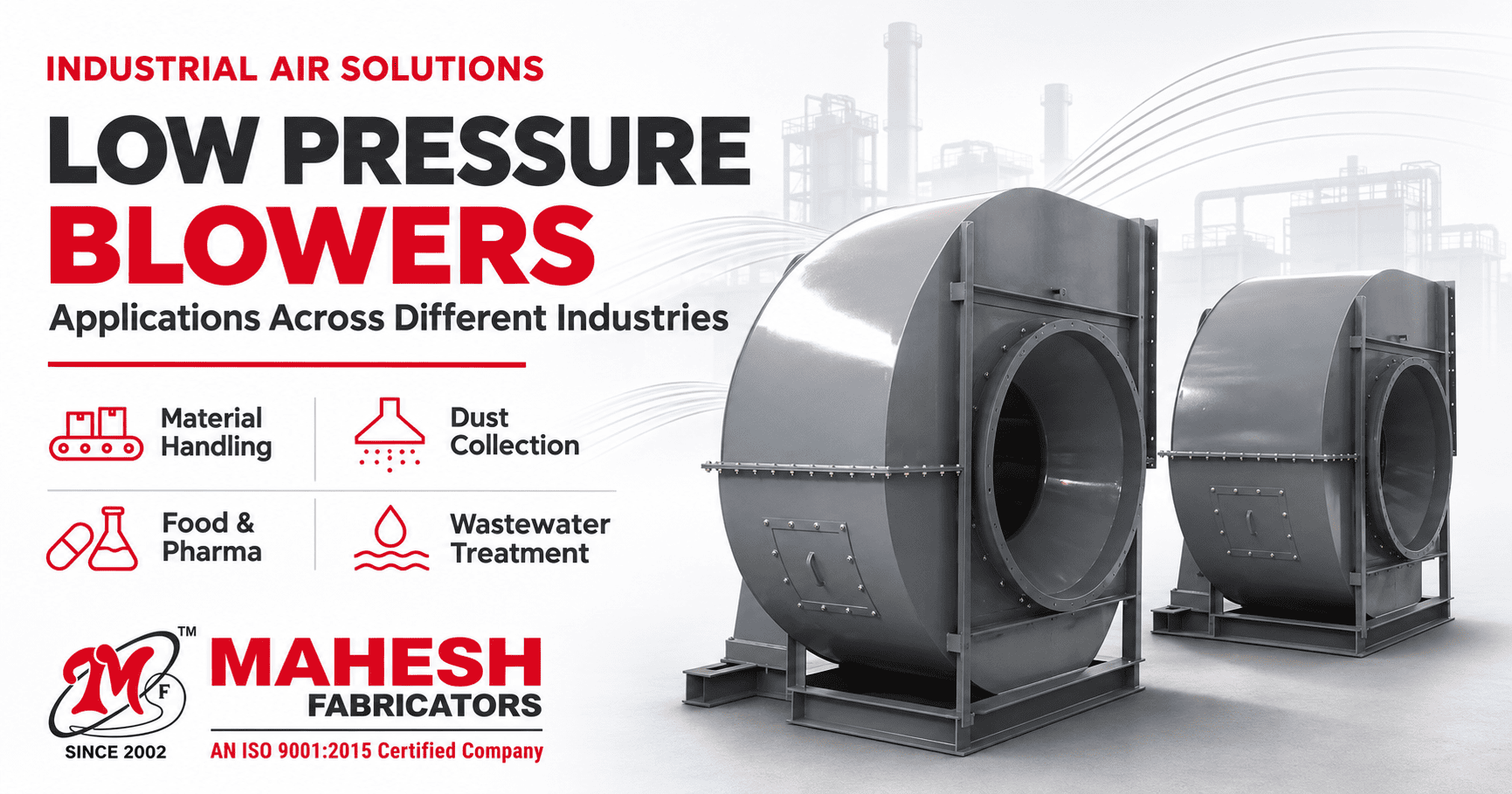
Low-pressure blowers are a critical type of industrial fan engineered to move large quantities of air at relatively low speeds and pressures. Typically, they operate within a pressure range of approximately 0.3 to 4 bar (though some definitions extend this slightly). Unlike their high-pressure counterparts, these blowers prioritize airflow volume over intense pressure, making them ideal for applications where gentle yet continuous air movement is required. They are known for their energy efficiency, quieter operation, and suitability for processes that demand consistent ventilation, drying, cooling, or conveying without the need for high force.
These blowers are often characterized by their robust construction, designed for continuous operation and reduced maintenance, a key consideration for industrial settings. Their versatility stems from their ability to efficiently facilitate processes such as dust collection, pneumatic conveying of bulk materials, and general ventilation in large industrial spaces.
Diverse Applications Across Industries
The adaptability of low-pressure blowers allows them to serve a multitude of functions in nearly every industrial sector. MAHESH FABRICATORS understands the unique air handling requirements of each sector and offers solutions to match.
Material Handling
Used for pneumatic conveying of powders, granules, and other bulk materials over short to medium distances, reducing manual labor and improving process flow.
Dust Collection Systems
Essential for creating the necessary airflow to capture and remove airborne dust, fumes, and particulate matter from manufacturing environments, ensuring cleaner air and safer working conditions.
Food & Beverage
Crucial for pneumatic conveying of products, cooling and drying processes, and aeration in wastewater treatment facilities within food production plants.
Pharmaceuticals
Employed to maintain controlled environments, ensure air quality in cleanrooms, and support specific processing and drying applications.
Foundry & Iron/Steel
Vital for removing fumes, dust, and heat generated during metal processing and casting operations.
Cement Plants
Utilized in various processes including pneumatic conveying of cement, combustion air supply, and cooling operations.
Wastewater Treatment
Provide essential aeration for aerobic biological processes that break down waste products, crucial for municipal and industrial wastewater management.
Agriculture
Used for grain aeration, drying processes, and ventilation in storage facilities.
Key Benefits of Low Pressure Blowers
Implementing low-pressure blowers in industrial settings offers significant advantages:
- Energy Efficiency: Designed to consume less power for the volume of air moved compared to higher-pressure systems.
- Reliability & Durability: Built for continuous operation with robust designs that ensure long service life and reduced downtime.
- Quieter Operation: Generally operate at lower noise levels than high-pressure alternatives, contributing to a better working environment.
- Low Maintenance: Often designed for simplicity and minimal lubrication requirements, reducing operational costs.
- Versatile Airflow: Ideal for applications requiring consistent, stable airflow for processes like ventilation, drying, and gentle conveying.
Selecting the Right Low Pressure Blower
Choosing the appropriate low-pressure blower is crucial for optimal performance and efficiency. MAHESH FABRICATORS advises considering the following factors:
Application Requirements
Clearly define the primary purpose: Is it for conveying, dust collection, ventilation, drying, or cooling? The specific application dictates airflow volume (CFM) and required static pressure. For example, dust collection might require higher static pressure than simple ventilation.
Airflow Volume & Pressure
Determine the required airflow rate (in CFM or m³/hr) and the total system pressure (static and velocity pressure) the blower must overcome. This is the most critical technical specification.
Operating Environment
Consider the conditions where the blower will operate: ambient temperature, presence of dust, corrosive elements, or moisture. Materials of construction and sealing may need to be adapted.
Material Being Handled (if applicable)
If the blower is used for conveying or dust collection, understand the properties of the material: particle size, abrasiveness, moisture content, and temperature. This influences blower design, such as impeller type and material.
Noise and Vibration Limits
Assess any site-specific noise restrictions or the need for vibration isolation, which might influence the choice of blower type or require additional dampening measures.
Energy Efficiency Goals
Evaluate the energy consumption of potential blowers. Investing in a more energy-efficient model can lead to significant cost savings over the blower's lifetime.
Maintenance Considerations
Inquire about the expected maintenance schedule and requirements. Blowers designed for reduced maintenance can significantly lower operational overhead.
MAHESH FABRICATORS: Your Partner for Air Systems
At MAHESH FABRICATORS, we specialize in manufacturing and supplying industrial air systems designed for performance and longevity. Our range includes custom-built centrifugal blowers, axial fans, and low-pressure blowers that can be tailored to meet your exact operational needs. We understand that effective dust collection, material handling, and ventilation are critical to your success. Our commitment is to provide user-friendly, reliable, and efficient air solutions with a focus on reducing maintenance costs.
We serve a broad spectrum of industries, including Textile, Pharma, Iron/Steel, Foundry, Ceramics, Plastics, Furnaces, Woodworking, Plywood MFG, Coal, Cement, Chemical, and more. Whether you require a standard industrial blower or a bespoke air system for a unique application, our team is dedicated to delivering quality and value.
Frequently Asked Questions
What is the primary difference between low-pressure and high-pressure blowers?
The main difference lies in their operating pressure. Low-pressure blowers are designed to move large volumes of air at low pressures, ideal for ventilation, drying, and conveying. High-pressure blowers generate significant pressure, suitable for applications like pneumatic transport over long distances or high-temperature gas handling.
How do low-pressure blowers contribute to energy efficiency?
Low-pressure blowers are optimized for moving air at lower pressures, which generally requires less energy input compared to generating higher pressures. Their design focuses on airflow volume efficiency, leading to lower operational costs.
Can low-pressure blowers be used for conveying materials?
Yes, low-pressure blowers are commonly used for pneumatic conveying of bulk materials like powders, granules, and pellets, especially over shorter distances where high pressure is not required. They provide the necessary airflow to move these materials through pipelines.
What industries commonly use low-pressure blowers for dust collection?
Industries such as manufacturing, woodworking, metal fabrication, cement production, and food processing frequently use low-pressure blowers as a key component of their dust collection systems to maintain air quality and workplace safety.
What should I consider when selecting a low-pressure blower for my application?
Key considerations include the required airflow volume (CFM), static pressure needed, the operating environment (temperature, dust, corrosiveness), the type of material being handled, noise level requirements, and energy efficiency goals. Consulting with a manufacturer like MAHESH FABRICATORS can help you determine the best fit.
Ready to Optimize Your Airflow?
Selecting the right low-pressure blower is crucial for the efficiency and success of your industrial operations. Whether for material handling, dust collection, ventilation, or specialized processes, MAHESH FABRICATORS offers custom-built solutions designed for performance and reliability.
Request a Consultation