How to Choose the Right Fan Impeller
The heart of any industrial fan or blower lies in its impeller – the component responsible for imparting kinetic energy to the air or gas being moved. Choosing the right fan impeller is a critical decision that directly impacts the efficiency, performance, and lifespan of your entire air handling system. With a variety of designs, materials, and applications, understanding the nuances of impeller selection can seem daunting. This guide, drawing on industry insights and the expertise of manufacturers like Mahesh Fabricators, aims to demystify the process, ensuring you make an informed choice for your specific operational needs.
Understanding Fan Impellers
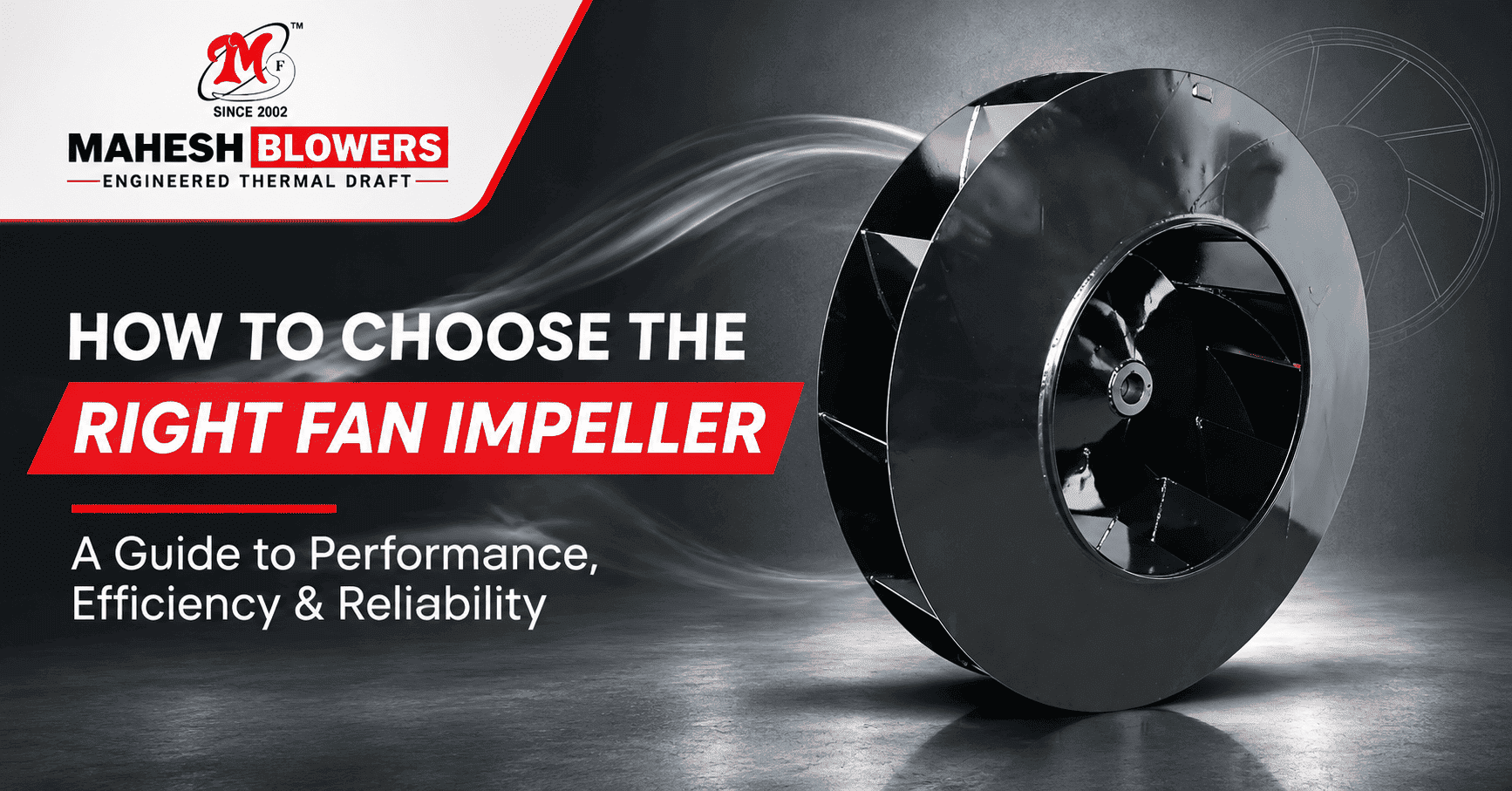
A fan impeller, also known as a fan wheel or blower wheel, is the rotating component of a fan or blower that creates airflow. It typically consists of a central hub and a series of blades attached to it. Depending on the design, it may also include back or side plates. The primary function of the impeller is to receive mechanical energy from a motor and convert it into aerodynamic energy, thereby moving air or gas.
The design and configuration of the impeller are paramount to its performance characteristics, influencing factors such as the volume of air moved, the pressure generated, energy consumption, and noise levels. Different industrial applications demand distinct impeller types, materials, and geometries to operate effectively and safely.
Types of Fan Impellers and Their Applications
Fan impellers are broadly classified based on the direction of airflow they generate relative to the axis of rotation. The three primary categories are centrifugal, axial, and mixed-flow impellers.
Centrifugal Fan Impellers
Centrifugal impellers draw air into the center (eye) of the rotating wheel and discharge it radially outwards, perpendicular to the shaft. These are highly versatile and can be designed for a wide range of pressure and flow requirements, from low-pressure ventilation to high-pressure industrial processes. They are particularly effective at overcoming resistance in ductwork, filters, or other system components.
Common subtypes include:
- Radial Blade: Robust, simple design, excellent for handling dust, fumes, and materials. Less efficient but highly durable.
- Radial Tip: Offers a balance between pressure capability and efficiency, suitable for moderately dusty conditions.
- Backward-Inclined/Curved: Highly efficient, operate at lower speeds for a given airflow, producing less noise. Ideal for clean air applications requiring high static pressure.
Axial Fan Impellers
Axial impellers move air parallel to the shaft axis. They are designed to move large volumes of air at low pressures. Common in general ventilation, cooling towers, and exhaust systems where minimal resistance is encountered. While efficient for high volume, low-pressure tasks, they are less suited for applications with significant duct resistance.
Mixed-Flow Impellers
As the name suggests, mixed-flow impellers combine characteristics of both centrifugal and axial designs. They draw air in axially and discharge it at an angle between axial and radial. These offer a compromise, capable of providing moderate pressure at moderate flow rates, making them suitable for a variety of HVAC and industrial applications where a balance is needed.
Key Criteria for Selecting the Right Fan Impeller
The selection of a fan impeller should be a meticulous process, considering several critical operational and environmental factors. Mahesh Fabricators, as a manufacturer of industrial air systems including fan impellers, understands the importance of matching these components precisely to the application.
Buyer Insight: Don't overlook the importance of impeller balance. Properly balanced impellers reduce vibration, prolong bearing and shaft life, and contribute to quieter operation and overall system reliability.
1. Airflow and Pressure Requirements
This is the most fundamental consideration. Determine the required airflow rate (measured in cubic feet per minute - CFM, or cubic meters per hour - CMH) and the static pressure (measured in inches of water gauge - "wg, or Pascals - Pa) the fan system needs to deliver. Different impeller types and geometries are optimized for different pressure/flow combinations.
2. Nature of the Conveyed Medium
The properties of the air or gas being moved are crucial. Will it be clean air, or will it contain dust, moisture, corrosive elements, or high temperatures? For applications with particulate matter, robust designs like radial blade impellers are often preferred due to their durability and ability to handle abrasive materials. For high temperatures, the material selection becomes critical to prevent creep or degradation.
3. Installation Conditions and Space Constraints
Consider the available space for the fan and its housing. Some impeller types require larger housings for a given airflow, while others are more compact. The overall system design, including ductwork and any obstructions, will influence the pressure requirements and, consequently, the impeller choice.
4. Energy Efficiency and Noise Levels
Backward-inclined or backward-curved impellers are generally the most energy-efficient options, especially for applications requiring higher static pressures. They also tend to operate more quietly than other types. While initial cost is a factor, the long-term energy savings and reduced noise pollution can make these a more economical choice overall.
5. Material Selection
The impeller material must be able to withstand the operational stresses, including centrifugal forces, bending moments, and the temperature of the conveyed medium. Common materials include various steel alloys, stainless steel, aluminum, and sometimes plastics for specific low-duty applications. For high-temperature environments, materials like aluminum might be considered, but their performance under sustained high stress and temperature must be carefully evaluated. Mahesh Fabricators utilizes robust materials suited for industrial environments.
6. Blade Design and Geometry
The number of blades, their angle, curvature, and width all play a significant role in the impeller's performance. For instance, more blades can increase pressure capability but may reduce efficiency if not optimally designed. Blade angles, particularly backward-inclined designs, enhance efficiency and stability. The overall impeller diameter and width also determine its capacity.
7. Balance Quality
Proper dynamic balancing of the impeller is essential for smooth, vibration-free operation. Imbalance can lead to premature wear of bearings, seals, and shafts, increasing maintenance costs and reducing the fan's lifespan. Manufacturers adhere to specific balancing standards (e.g., ISO 1940) to ensure optimal performance.
Diverse Applications Across Industries
The need for reliable fan impellers spans a vast array of industrial sectors. Mahesh Fabricators proudly serves many of these, providing critical components for:
| Industry | Typical Impeller Use Case |
|---|---|
| Textile | Dust collection, ventilation, humidification systems |
| Pharma | Cleanroom ventilation, HVAC systems, dust extraction |
| Iron/Steel & Foundry | Furnace ventilation, material handling, dust collection |
| Ceramics | Kiln ventilation, dust control, material transport |
| Plastics | Process cooling, fume extraction, material conveying |
| Plywood MFG | Dust collection, ventilation, drying processes |
| Coal & Cement | Material handling, dust collection, process ventilation |
| Chemical | Fume extraction, process ventilation, material transport |
Mahesh Fabricators: Your Partner for Fan Impellers
Founded in 2002 and ISO 9001-2015 Certified, Mahesh Fabricators specializes in manufacturing high-quality industrial air systems. Our product portfolio includes a comprehensive range of blowers, fans, and their essential accessories, such as precisely engineered fan impellers. We understand that the right impeller is not just a part, but a crucial element contributing to the overall efficiency and reliability of your industrial processes.
We offer a variety of impeller designs, fabricated from materials chosen for their durability and suitability to diverse industrial conditions. Whether your application involves moving large volumes of air, handling abrasive materials, or operating in high-temperature environments, Mahesh Fabricators has the capability to provide the right solution. Our commitment is to deliver components that meet stringent quality standards, ensuring optimal performance and longevity for your air handling equipment.
Buyer's Checklist: Questions to Ask Before Buying
Before making a purchase, arm yourself with the right information. Asking these questions will help ensure you select the most appropriate fan impeller:
Essential Considerations:
- What is the exact airflow (CFM/CMH) and static pressure ("wg/Pa) required for my application?
- What type of medium will the impeller handle (clean air, dust, chemicals, temperature)?
- Are there specific material requirements due to corrosion, abrasion, or temperature?
- What are the space limitations for the fan housing and impeller assembly?
- What are the acceptable noise level limits for the operating environment?
- What is the required lifespan and expected maintenance schedule?
- Does the impeller need to be dynamically balanced to a specific standard?
- What are the compatibility requirements with the existing motor and fan housing?
Frequently Asked Questions
What is the difference between centrifugal and axial impellers?
Centrifugal impellers draw air in axially and discharge it radially, generating higher pressure suitable for overcoming resistance. Axial impellers move air parallel to the shaft, designed for high volume, low-pressure applications where resistance is minimal.
Can fan impellers be used for high-temperature applications?
Yes, but the material selection is crucial. Certain alloys, like specific grades of aluminum or stainless steel, can be used for high-temperature environments. It's important to ensure the material can withstand the thermal stresses and potential creep under load.
Why is dynamic balancing important for fan impellers?
Dynamic balancing ensures the impeller rotates smoothly and without vibration. An unbalanced impeller can cause excessive wear on bearings, shafts, and seals, leading to premature failure, increased noise, and reduced operational efficiency.
How does impeller blade design affect performance?
Blade design—including curvature, angle, number, and shape—significantly impacts airflow volume, static pressure capabilities, energy efficiency, and noise generation. Backward-curved blades, for example, are known for their high efficiency and stable performance.
What does ISO 9001-2015 certification mean for Mahesh Fabricators' impellers?
This certification signifies that Mahesh Fabricators adheres to rigorous quality management standards in their manufacturing processes. It assures customers that our fan impellers are produced with a focus on consistency, reliability, and customer satisfaction.
Conclusion
Selecting the correct fan impeller is a cornerstone of efficient and reliable industrial air handling. By carefully considering the airflow and pressure requirements, the nature of the medium, material properties, and operational environment, you can identify the impeller type best suited to your needs. Consulting with experienced manufacturers like Mahesh Fabricators, who offer a range of high-quality, ISO 9001-2015 certified industrial air system components, ensures you receive expert guidance and a product designed for performance and durability.
Ready to Optimize Your Airflow?
Contact Mahesh Fabricators today to discuss your specific fan impeller requirements. Our team is dedicated to providing robust, efficient, and tailored solutions for your industrial air system needs.