High Pressure vs Low Pressure Blowers: Complete Comparison
In the realm of industrial air systems, the choice between a high-pressure blower and a low-pressure blower is a pivotal decision that significantly impacts operational efficiency, energy consumption, and overall system performance. While both serve the fundamental purpose of moving air, their distinct operational characteristics make them suitable for vastly different applications. Understanding these differences is crucial for engineers, plant managers, and procurement specialists tasked with selecting the right equipment for their specific industrial needs. Mahesh Fabricators, an ISO 9001-2015 certified company with over two decades of experience in manufacturing industrial air systems and pollution control equipment, offers a range of centrifugal fans and blowers, including both high and low-pressure variants, designed to meet the rigorous demands of diverse industries.
Understanding Industrial Blowers
Industrial blowers are essential components in numerous manufacturing and processing operations. They are designed to move air or other gases in continuous volumes, playing critical roles in ventilation, material handling, combustion, cooling, and emission control. The fundamental difference between high-pressure and low-pressure blowers lies in their ability to generate static pressure – the force that overcomes resistance within a duct system or process. This distinction dictates their suitability for various tasks, from forcing air through extensive pipelines to providing gentle airflow for ventilation.
Centrifugal blowers, a common configuration in industrial settings, utilize an impeller to accelerate air and impart kinetic energy, which is then converted into pressure as the air is forced through a housing. The design of the impeller, housing, and motor determines whether the blower is optimized for high pressure with lower volume or low pressure with higher volume. Mahesh Fabricators specializes in manufacturing robust centrifugal fans and blowers, understanding the nuanced requirements of each application.
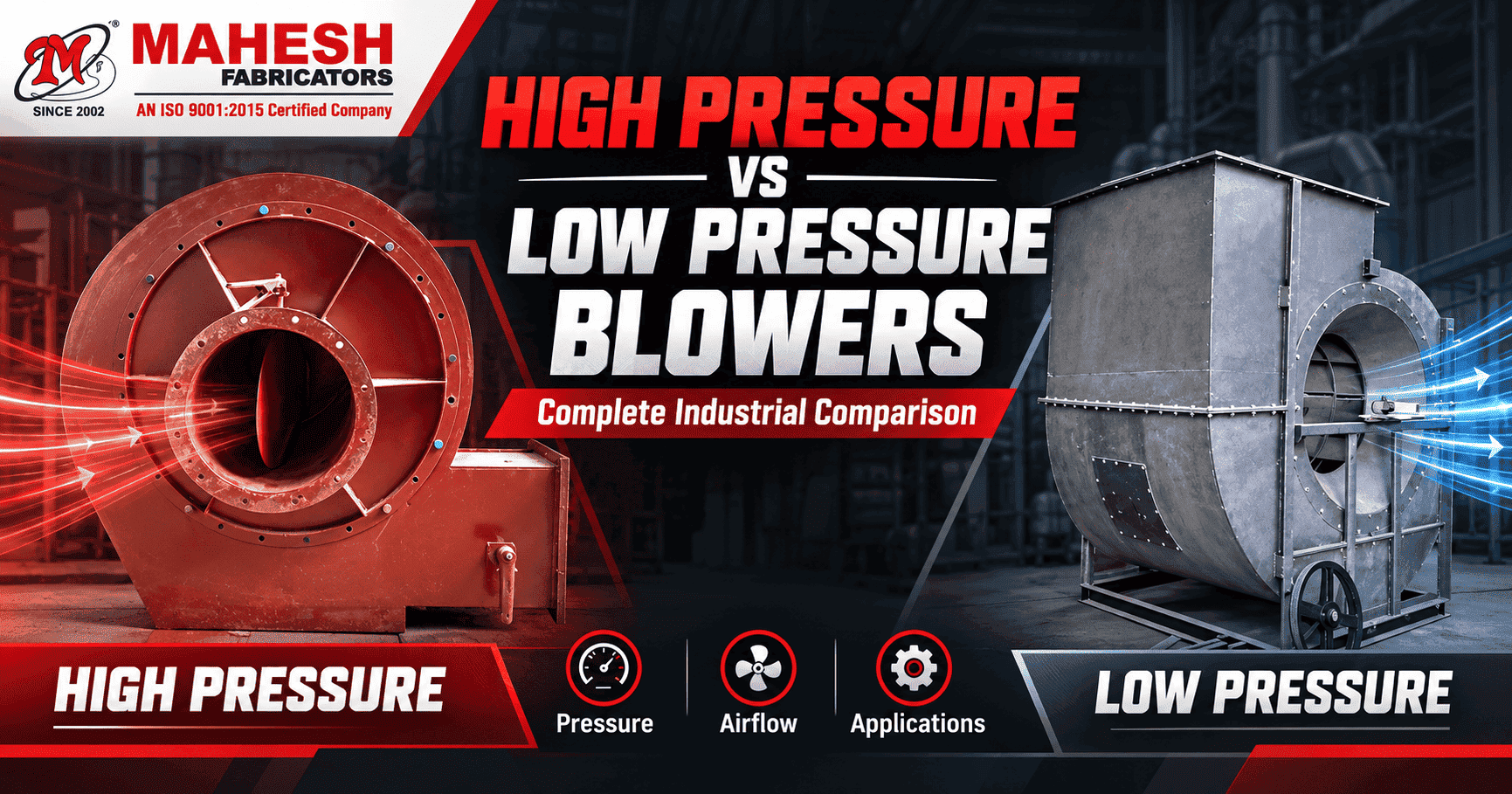
High Pressure vs. Low Pressure Blowers: Key Distinctions
The primary differentiator between these two types of blowers is their pressure output capability. This leads to significant differences in their design, airflow characteristics, and typical applications.
High Pressure Blowers
- Pressure Output: Capable of generating significant static pressure (measured in Pascals (Pa) or inches of water gauge (in. wg)).
- Airflow: Typically offer lower airflow volumes (measured in Cubic Feet per Minute (CFM) or cubic meters per hour (m³/h)) for a given size compared to low-pressure blowers.
- Design: Often feature smaller impellers with narrower blades operating at higher speeds, designed to withstand and overcome high resistance.
- Applications: Ideal for pushing air through long, narrow ducts, dense filtration systems, pneumatic conveying, combustion air supply for furnaces and boilers, and processes with high system resistance.
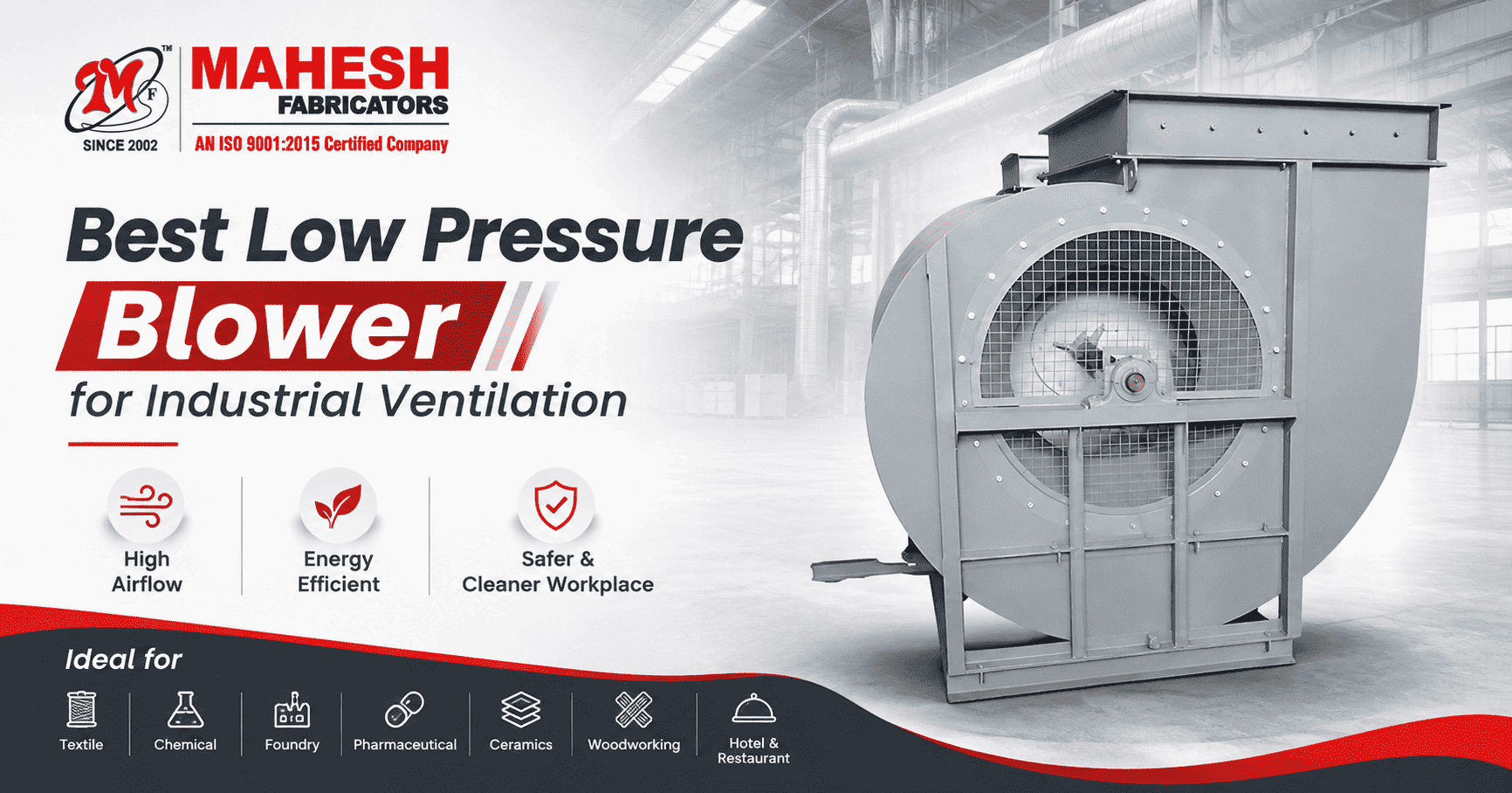
Low Pressure Blowers
- Pressure Output: Generate relatively lower static pressure.
- Airflow: Designed to move large volumes of air efficiently against minimal resistance.
- Design: Often feature larger impellers with wider blades operating at lower speeds, optimized for high volume delivery.
- Applications: Suited for general ventilation, cooling systems, drying processes, dust collection systems with minimal ducting, and air knives where high volume is key.
The selection between these two hinges on the system's resistance. Even a blower designed for high volume can struggle if it's pushing air through a system with significant backpressure. Conversely, a high-pressure blower might be overkill and inefficient for simple ventilation tasks.
Diverse Applications Across Industries
The versatility of industrial blowers means they are indispensable across a wide spectrum of industries. Mahesh Fabricators' products are integral to operations in sectors like Textile, Pharma, Iron/Steel, Foundry, Ceramics, Plastics, Furnaces, Cotton/Woodworking, Plywood MFG, Coal, Cement, Chemical, and Hotel/Restaurant.
Application Scenarios
Pneumatic Conveying
Requires high-pressure blowers to move bulk materials (powders, granules) through long pipelines against significant resistance.
Combustion Air Supply
Furnaces and boilers often need high-pressure blowers to ensure efficient fuel combustion by providing adequate airflow into the combustion chamber.
Industrial Ventilation
Low-pressure, high-volume blowers are essential for circulating fresh air, removing heat, and managing air quality in large industrial spaces.
Cooling Systems
Electronics, machinery, and specific industrial processes often rely on low-pressure blowers for effective cooling, moving air over heat-generating components.
Dust and Fume Extraction
While some systems require high pressure for long duct runs, others with shorter, wider ducts use low-pressure blowers to capture and remove airborne contaminants.
Drying Processes
Both types can be used depending on the application; some drying tunnels might use high-pressure air jets, while general drying might benefit from high-volume, lower-pressure airflow.
Key Benefits of Proper Blower Selection
Selecting the correct blower configuration is not merely about moving air; it's about optimizing an entire industrial process. Mismatches can lead to substantial inefficiencies and costly failures.
Advantages
Energy Efficiency
Choosing a blower that precisely matches the system's pressure and volume requirements prevents energy waste, leading to lower operating costs. Electric motor systems account for a significant portion of industrial energy usage, making this optimization crucial.
Optimized Process Performance
Correct airflow and pressure ensure processes run as intended, whether it's for efficient combustion, effective material transport, or adequate ventilation, preventing system choke or insufficient air delivery.
Enhanced Reliability and Longevity
Operating a blower within its designed parameters reduces stress on the motor and impeller, minimizing wear and tear, and preventing premature hardware failures.
Reduced Noise Levels
Low-pressure blowers, particularly those optimized for high volume, can often operate more quietly than high-pressure units, contributing to a better working environment.
Buyer's Guide: Selecting the Right Blower
When specifying a blower, particularly from a reputable manufacturer like Mahesh Fabricators, consider these critical factors:
Buyer Insight:
System resistance is the hidden variable. Factors like duct length, diameter, bends, dampers, filters, and thermal expansion all contribute to static pressure. Always consider the total system resistance when selecting a blower, not just the desired airflow.
Key Selection Criteria
Required Airflow (CFM/m³/h)
Determine the precise volume of air needed for the application. This is often the starting point for selection.
System Static Pressure (Pa/in. wg)
Calculate or estimate the total resistance the blower must overcome. This is crucial for differentiating between high and low-pressure needs.
Operating Temperature & Environment
Consider the temperature of the air being moved and the ambient conditions. Industrial environments can be harsh, requiring robust construction.
Power Source & Efficiency
Ensure compatibility with available power and prioritize energy efficiency to minimize long-term operational costs. Look for blower designs that match motor characteristics.
Noise Level Requirements
If noise is a concern, evaluate the acoustic performance of different blower types and consider noise-reduction measures.
Maintenance & Reliability
Choose designs known for durability and ease of maintenance, especially for continuous-duty applications. ISO 9001-2015 certification, like that held by Mahesh Fabricators, indicates a commitment to quality management systems.
Mahesh Fabricators: Your Partner for Industrial Air Solutions
Established in 2002, Mahesh Fabricators has built a strong reputation as an ISO 9001-2015 certified manufacturer of industrial air systems and air pollution control equipment. Their expertise extends to a comprehensive range of centrifugal fans and blowers, including precisely engineered high-pressure and low-pressure blowers. Whether your operations demand the power to move materials through extensive conveying systems or the high-volume airflow required for efficient plant ventilation, Mahesh Fabricators offers reliable solutions tailored to your specific needs.
Their commitment to quality manufacturing ensures that each blower, whether it's a high-pressure centrifugal blower for demanding industrial processes or a low-pressure variant for large-scale air movement, is built for durability and performance. By understanding the intricate interplay between airflow, pressure, and system resistance, Mahesh Fabricators provides industrial air systems that contribute to the operational success of clients across various demanding sectors.
Frequently Asked Questions
What is the main difference between a high pressure and a low pressure blower?
The primary difference lies in their capacity to generate static pressure. High-pressure blowers are designed to overcome significant resistance in ductwork or systems, while low-pressure blowers are optimized for moving large volumes of air with minimal resistance.
Can a low-pressure blower be used for a high-pressure application?
Generally, no. A low-pressure blower will not be able to provide the necessary force to move air effectively through a high-resistance system. This can lead to insufficient airflow, system inefficiency, and potential damage to the blower.
How does system resistance affect blower selection?
System resistance, measured as static pressure, is a critical factor. A system with long ducts, many bends, filters, or other obstructions will have high resistance, requiring a high-pressure blower. A system with short, direct ducting will have low resistance, suitable for a low-pressure blower.
What industries commonly use high-pressure blowers?
Industries such as cement, coal, chemical, iron/steel, foundries, and those involved in pneumatic conveying or high-temperature processes (furnaces, boilers) frequently utilize high-pressure blowers.
What industries commonly use low-pressure blowers?
Industries like textiles, pharmaceuticals, food processing, and HVAC, as well as applications requiring general ventilation, cooling, or dust collection with minimal ducting, typically use low-pressure blowers.
How can I ensure I'm buying the most efficient blower?
Consult with a manufacturer like Mahesh Fabricators. Provide them with your system's exact airflow and static pressure requirements, operating environment, and any other relevant process details. Proper sizing based on these parameters is key to efficiency.
Ready to Optimize Your Airflow?
Selecting the right high-pressure or low-pressure blower is crucial for the efficiency and reliability of your industrial operations. Leverage the expertise of Mahesh Fabricators, an ISO 9001-2015 certified manufacturer with extensive experience in industrial air systems.
Request a Consultation