Introduction
Tyre recycling is one of the fastest-growing industries worldwide. During the shredding process, used tyres are broken down into chips, granules, and powder. While this step is essential for resource recovery, it also produces large amounts of rubber dust, textile fibres, and steel fines that increase safety risks, accelerate equipment wear, and contribute to air pollution.
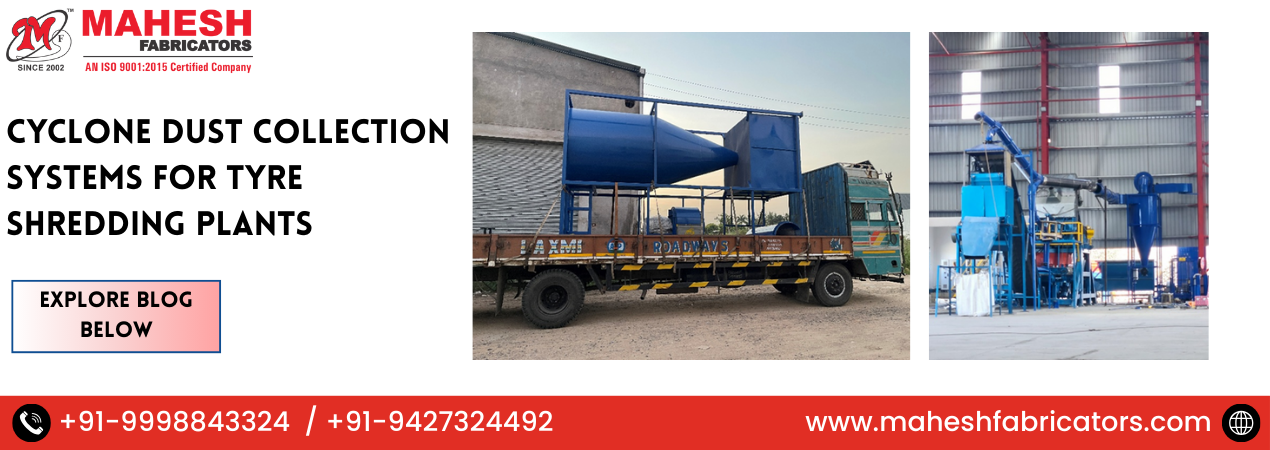
A cyclone dust collection system is the ideal solution for controlling dust at the shredding stage. By capturing coarse to medium-sized particles, cyclone collectors ensure a cleaner, safer, and more efficient tyre recycling operation.
Description: How Cyclone Dust Collectors Work
A cyclone dust collector uses centrifugal force to separate dust and rubber particles from the airstream. Dust-laden air enters the cyclone chamber tangentially, creating a spinning vortex. Heavier particles are thrown outward, fall into a hopper, and are collected, while clean air exits through the top.
In tyre shredding plants, cyclones are often installed before a baghouse filter. This two-stage system ensures maximum efficiency: cyclones handle coarse particles, while baghouses capture fine respirable dust.
Key Features of Cyclone Dust Collection Systems
- Custom airflow capacity
- Heavy-duty construction
- High separation efficiency
- Modular designs
- Low maintenance
- Sealed hoppers with rotary valves
- Optional secondary filtration
- Compliance with safety & emission standards
Benefits for Tyre Shredding & Recycling Plants
- Cleaner working environment
- Protects downstream filters
- Enhances worker safety
- Improves equipment life
- Energy-efficient operation
- Reclaimable dust
Applications
- Tyre recycling & shredding plants
- Rubber granulating & powdering units
- Steel bead separation processes
- Textile fiber recovery from tyres
- General industrial dust control (cement, biomass, metal, wood)
Frequently Asked Questions (FAQ)
-
Q1: Can a cyclone alone handle all tyre shredding dust?
No. Cyclones capture coarse to medium dust effectively. For fine respirable particles (<10 microns), a downstream baghouse or cartridge filter is required. -
Q2: How efficient are cyclone collectors?
Cyclones typically achieve 85–99% efficiency for particles >50 microns. Efficiency decreases for finer dust. -
Q3: What is the maintenance requirement?
Very low. Routine inspections of hopper discharge, liners, and ductwork are sufficient. -
Q4: Can captured dust be reused?
Yes. Rubber fines collected from the hopper can be reprocessed into new products. -
Q5: Are cyclone systems suitable for continuous operation?
Yes. With rotary valves and automated dust discharge, cyclones can run 24/7 in shredding plants.
Conclusion
- Cyclone dust collection systems are a critical investment for tyre shredding and recycling plants. They ensure dust control, protect workers, reduce equipment wear, and enhance regulatory compliance. When combined with secondary filtration, they deliver maximum air quality and efficiency for modern recycling operations.
- 👉 Looking to install a customized cyclone dust collection system for your tyre shredding plant? Contact an industrial dust collection expert with your plant’s airflow, capacity, and dust load data for a tailored solution.