What Is an Axial Flow Fan and How Does It Work?
Axial flow fans are indispensable in modern industrial operations, playing a critical role in managing air movement. Unlike other fan types, they move air along a straight line, parallel to the axis of rotation. This design makes them exceptionally efficient for applications requiring large volumes of air at relatively low pressures. Understanding what an axial flow fan is and how it works is key to optimizing ventilation, cooling, and process air systems across a vast array of sectors.
Mahesh Fabricators, an ISO 9001-2015 Certified Company established in 2002, specializes in manufacturing robust industrial air systems, including a range of high-performance axial flow fans. Designed with user expectations in mind, their products aim to deliver reliable operation with reduced maintenance. This guide delves into the core principles of axial flow fans, their operational mechanisms, diverse applications, crucial benefits, and factors to consider when selecting the right unit for your industrial needs.
What Is an Axial Flow Fan?
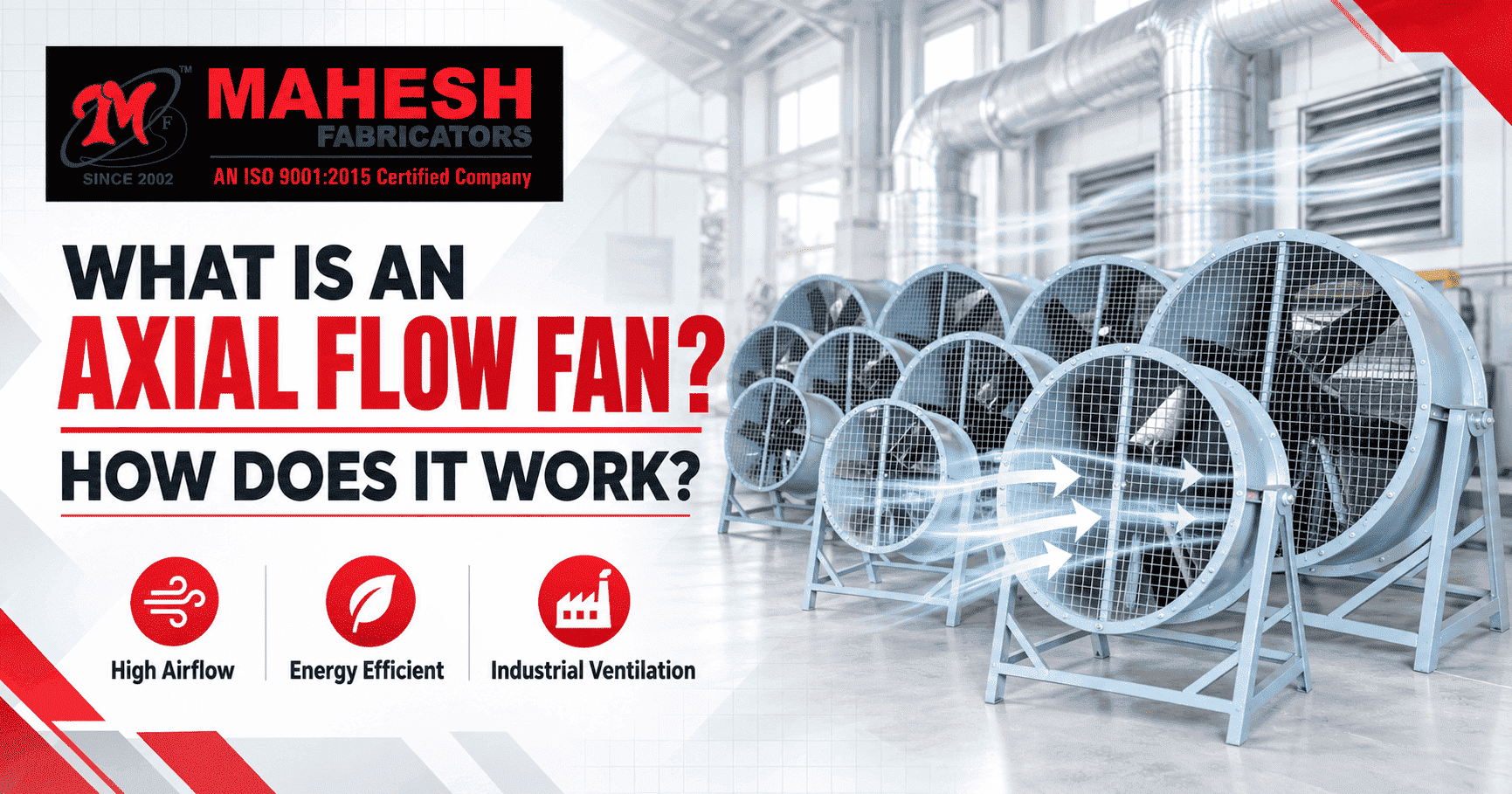
An axial flow fan is a type of mechanical fan that creates airflow by moving air parallel to its shaft or axis. Imagine a propeller in an airplane; it pulls air into the fan and expels it in the same direction. This is the fundamental principle behind axial flow fans. They consist of a fan impeller (blades) mounted on a shaft driven by an electric motor or other prime mover. As the impeller rotates, its blades exert force on the air, accelerating it and directing it outwards along the fan's axis of rotation.
The key distinguishing feature is the direction of airflow relative to the fan's rotational axis. In contrast, centrifugal fans move air radially, at a 90-degree angle to the shaft, which is better suited for applications requiring higher pressure. Axial fans, however, excel in situations where moving a large volume of air efficiently is the primary goal.
💡 Buyer Insight:
When considering an industrial fan, the primary distinction often lies in whether you need high volume at low pressure (axial) or high pressure at lower volume (centrifugal). Axial flow fans are your go-to for general ventilation, exhaust, and circulation tasks.
How Does an Axial Flow Fan Work?
The operation of an axial flow fan is a study in aerodynamic efficiency. It relies on the principle of airfoil lift:
- Blade Design: The fan impeller features blades shaped like airfoils, similar to airplane wings. These blades are mounted at a specific angle (pitch) to the shaft.
- As the motor rotates the shaft, the blades spin rapidly.
- The airfoil shape causes air to flow faster over one side of the blade than the other.
- This pressure difference generates lift, which in turn pushes the air forward.
- Air Intake: Air is drawn into the fan housing, perpendicular to the plane of rotation.
- Air Acceleration: As the impeller rotates, the spinning blades impart kinetic energy to the air. The angled blades create a continuous thrust that pushes the air stream axially.
- Air Discharge: The air is expelled in a relatively straight stream, parallel to the fan's shaft, at a higher velocity than it entered.
The volume of air moved is primarily determined by the fan's diameter, rotational speed (RPM), and blade design (pitch and shape). Pressure is generated by the velocity imparted to the air. While axial fans can generate some static pressure, they are most effective in systems where the resistance to airflow is low.
Applications and Use Cases
The versatility and efficiency of axial flow fans make them suitable for a wide range of industrial applications. Their ability to move large quantities of air makes them essential for maintaining healthy and productive environments:
General Ventilation
Maintaining fresh air supply and removing stale air in large industrial spaces, warehouses, and workshops.
Industrial Exhaust Systems
Removing fumes, dust, and heat generated from manufacturing processes in sectors like iron/steel, foundry, and chemical plants.
Process Air Circulation
Ensuring uniform temperature and air quality in drying ovens, furnaces, and climate-controlled environments found in ceramics and pharma industries.
Cooling Towers & HVAC
Essential for heat rejection in cooling towers and for circulating air within large heating, ventilation, and air conditioning systems.
Textile Industry
Managing airflow for ventilation and process control in spinning, weaving, and fabric finishing operations.
Woodworking & Plywood
Dust extraction and ventilation in plywood manufacturing and general woodworking facilities.
These fans are crucial for maintaining optimal operating conditions, ensuring worker safety, and improving product quality across diverse industries such as Textile, Pharma, Iron/Steel, Foundry, Ceramics, Plastics, Furnaces, Cotton/Woodworking, Plywood MFG, Coal, Cement, Chemical, and Hotels/Restaurants.
Key Benefits of Axial Flow Fans
Choosing the right fan can significantly impact operational efficiency and cost. Axial flow fans offer several compelling advantages:
- High Airflow Capacity: They are designed to move large volumes of air efficiently, making them ideal for general ventilation and exhaust applications where air exchange rates are high.
- Energy Efficiency: When applied correctly to low-resistance systems, axial fans can be more energy-efficient than other types, leading to lower operating costs.
- Compact Design: Many axial fan designs are relatively compact for their airflow capacity, requiring less installation space compared to some other fan configurations.
- Low Maintenance: Mahesh Fabricators focuses on user-friendly operations and reduced maintenance costs, ensuring their axial flow fans are durable and reliable.
- Versatility: Their applicability spans numerous industries and functions, from simple air circulation to more specific process air control.
Selecting the Right Axial Flow Fan
Choosing an appropriate axial flow fan involves careful consideration of your specific application requirements. Here’s a guide to help you make an informed decision:
Factors to Consider:
Performance Requirements
- Airflow Rate (CFM/CMH): Determine the volume of air that needs to be moved per minute or hour.
- Static Pressure (Inches w.g./Pascals): While axial fans are low-pressure devices, understand the system resistance to ensure adequate airflow.
- Temperature: Ensure the fan is rated for the operating temperature range of your environment.
Environmental Conditions
- Air Quality: Consider if the air contains corrosive elements, dust, or moisture that might require special materials or coatings.
- Noise Level: Some applications have strict noise regulations.
Operational Needs
- Duty Cycle: Will the fan operate continuously or intermittently?
- Power Source: Ensure compatibility with available electrical power.
Questions to Ask Before Buying:
To ensure you select the most suitable axial flow fan, consider asking potential suppliers:
- What is the rated airflow and static pressure for this fan model?
- What materials are used in construction, and are they suitable for my specific operating environment?
- What are the expected maintenance requirements and recommended service intervals?
- What is the power consumption at typical operating points?
- Does the fan meet any relevant industry standards for performance and safety?
By carefully evaluating these factors and asking the right questions, you can identify an axial flow fan that will deliver reliable and efficient performance for your industrial needs.
Mahesh Fabricators: Your Partner in Industrial Air Systems
For businesses seeking reliable and efficient air movement solutions, Mahesh Fabricators offers a trusted range of industrial air systems, including high-quality axial flow fans. As an ISO 9001-2015 Certified Company founded in 2002, they are committed to manufacturing products that meet stringent customer expectations while minimizing maintenance costs and ensuring user-friendly operations.
Their expertise spans across various industries, providing tailored solutions for sectors including Textile, Pharma, Iron/Steel, Foundry, Ceramics, Plastics, Furnaces, Cotton/Woodworking, Plywood MFG, Coal, Cement, Chemical, and Hotels/Restaurants. When you need robust air systems designed for performance and longevity, Mahesh Fabricators leverages its experience to deliver products that contribute to a safer, more productive working environment.
Frequently Asked Questions
What is the primary difference between an axial flow fan and a centrifugal fan?
The main difference lies in the direction of airflow. Axial flow fans move air parallel to the shaft, suitable for high volume, low-pressure applications. Centrifugal fans move air radially (at a 90-degree angle to the shaft), better suited for high-pressure, lower-volume requirements.
Can axial flow fans be used for exhausting hot air?
Yes, axial flow fans are commonly used in exhaust systems to remove hot air and fumes from industrial environments, helping to maintain safe operating temperatures and air quality.
Are axial flow fans energy-efficient?
Axial flow fans can be very energy-efficient when used in applications with low system resistance, such as general ventilation or large-scale air circulation. Their efficiency is optimized for moving large air volumes.
How do I choose the correct size axial flow fan?
Selecting the correct size involves assessing your required airflow rate (volume of air needed) and the static pressure of your system (resistance to airflow). It’s advisable to consult with a fan manufacturer like Mahesh Fabricators to match your specific needs to the right fan model.
Ready to Optimize Your Airflow?
Ensure your industrial operations benefit from efficient and reliable air movement. Explore the range of industrial air systems, including high-performance axial flow fans, from Mahesh Fabricators. Contact us today to discuss your specific requirements and find the perfect solution for your ventilation, exhaust, and circulation needs.
Get a Custom Solution