Industrial Air Dampers: Types & Applications
Industrial air dampers are vital components in managing airflow within complex industrial environments. These precisely engineered devices play a critical role in controlling, regulating, and isolating air streams, ensuring operational efficiency, safety, and environmental compliance. From high-temperature furnaces to pharmaceutical cleanrooms, industrial dampers are indispensable. This comprehensive guide delves into the various types of industrial air dampers, their diverse applications, and the key considerations for selecting the right solution for your specific needs, brought to you by Mahesh Fabricators, a trusted name in industrial air systems.
What Are Industrial Air Dampers?
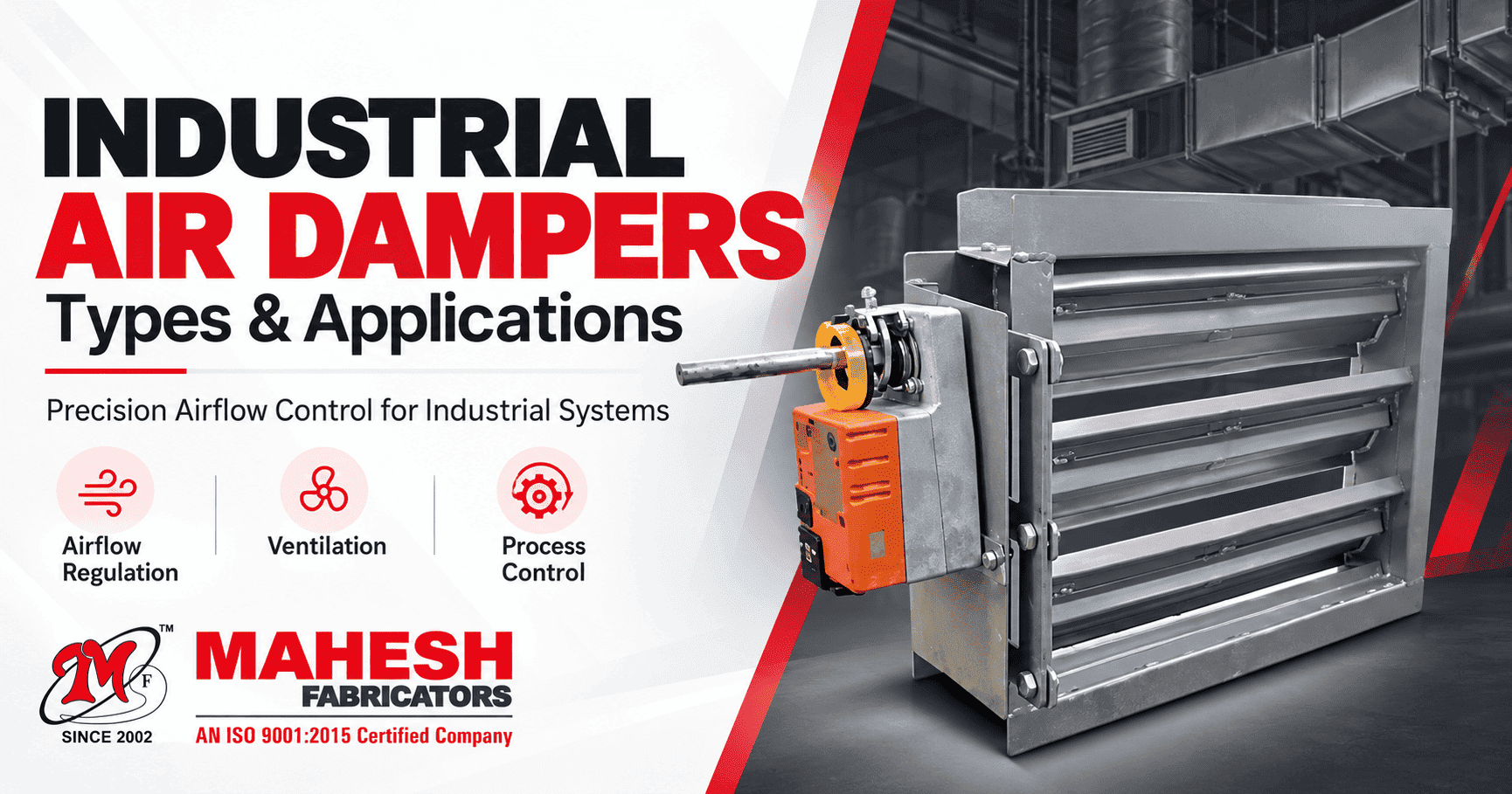
Industrial air dampers are mechanical devices, typically consisting of adjustable blades within a frame, designed to control or regulate the flow of air within ductwork, ventilation systems, or other air-handling applications. Unlike simple louvers, industrial dampers are built to withstand challenging operational conditions, including extreme temperatures, corrosive atmospheres, high particulate loads, and stringent hygiene requirements. Their primary function is to modulate or completely block airflow, thereby enabling precise control over ventilation, pressure, and temperature within industrial processes.
By adjusting the position of their blades, dampers can precisely manage the volume of air passing through a duct. This control is essential for maintaining optimal operating conditions, preventing the spread of contaminants, ensuring worker safety, and improving energy efficiency in various industrial settings.
Types of Industrial Air Dampers
The diversity of industrial applications necessitates a range of damper designs, each suited for specific functions. Key types include:
Multi-Blade Control Dampers
These dampers feature multiple blades that can be operated independently or in unison. They are designed for precise airflow regulation and shut-off applications, offering fine-tuned control over air volumes. Blade configurations can be parallel (for on/off or basic modulation) or opposed (for more accurate modulation).
Backdraft Dampers
Designed to allow airflow in only one direction, backdraft dampers automatically close when airflow reverses, preventing unwanted backflow. They are crucial for protecting sensitive equipment and maintaining system integrity.
Pressure-Relief Dampers
These dampers are engineered to open automatically when system pressure exceeds a predetermined setpoint, releasing excess air. They prevent over-pressurization, which can damage equipment and create hazardous conditions.
Bubble-Tight Dampers
Offering a high degree of sealing capability, bubble-tight dampers are designed to prevent leakage even when closed. They are essential in applications where complete shut-off is required, such as in cleanrooms or hazardous environments.
Guillotine Dampers
Featuring a single solid blade that slides vertically into a frame, guillotine dampers are primarily used for full shut-off applications, particularly in high-temperature or high-particulate environments where a robust isolation solution is needed.
Isolation Dampers
Used to completely shut off a section of ductwork for maintenance or operational purposes, isolation dampers ensure safety by preventing airflow into a specific zone.
Applications of Industrial Air Dampers
Industrial dampers find applications across a vast spectrum of industries, each leveraging their unique capabilities to solve specific airflow challenges:
| Industry | Typical Damper Application | Key Benefit |
|---|---|---|
| Textile | Dust collection, process ventilation, temperature control | Improved air quality, operational efficiency |
| Pharma | Cleanroom pressure control, isolation of processing areas | Contamination prevention, compliance |
| Iron/Steel & Foundry | Furnace air supply regulation, fume extraction, cooling | Process control, safety, emissions management |
| Ceramics | Kiln temperature control, dryer airflow management | Consistent product quality, energy savings |
| Plastics | Drying ovens, process ventilation, fume control | Product integrity, worker safety |
| Chemical | Corrosive fume handling, process isolation, ventilation | Material integrity, safety, environmental protection |
| Cotton/Woodworking | Dust collection, material handling ventilation | Reduced fire risk, improved air quality |
| General HVAC | Zone control, fresh air intake regulation, economizer modes | Energy efficiency, occupant comfort |
Beyond these specific industries, dampers are critical in applications such as:
- Fan Airflow Control: Regulating the volume of air supplied or extracted by industrial fans.
- By-Pass Systems: Directing airflow around equipment for process control or cooling.
- Shut-Off and Isolation: Creating barriers for maintenance, safety, or operational segmentation.
- Pressure Relief: Protecting systems from over-pressurization.
Key Benefits of Industrial Air Dampers
Implementing the right industrial air dampers offers significant advantages:
- Enhanced Process Control: Achieve precise regulation of airflow, temperature, and pressure critical for manufacturing consistency.
- Improved Safety: Prevent over-pressurization, manage hazardous fumes, and ensure safe working environments.
- Energy Efficiency: Optimize airflow to reduce energy consumption by preventing unnecessary ventilation or heat loss.
- System Protection: Safeguard equipment from damaging pressure surges or preventing backflow.
- Environmental Compliance: Control emissions and maintain air quality standards.
- Operational Flexibility: Enable efficient maintenance and operational adjustments through isolation capabilities.
Buyer's Guide: Selecting the Right Industrial Air Damper
Choosing the correct industrial air damper is paramount for system performance and longevity. Consider the following factors:
Critical Selection Criteria:
- Application Requirements: Clearly define the damper's primary function – control, isolation, backdraft prevention, pressure relief, etc.
- Operating Environment: Assess temperature extremes, presence of corrosive elements, dust levels, and humidity.
- Airflow Characteristics: Understand the required airflow volume, velocity, and pressure drop tolerance.
- Blade Type: Parallel blades are often suitable for on/off applications, while opposed blades provide better modulation.
- Materials of Construction: Select materials resistant to the operating environment. Common options include various grades of steel, aluminum, and stainless steel (e.g., 316 stainless steel for superior corrosion resistance).
- Actuation Method: Determine if manual, electric, pneumatic, or hydraulic actuation is needed based on control requirements and accessibility.
- Sealing Performance: If tight shut-off is critical, opt for bubble-tight or high-sealing designs.
Buyer Insight:
Always consider the long-term operational costs, including maintenance and energy consumption, when selecting a damper. A slightly higher initial investment in a robust, appropriately specified damper can yield significant savings and reliability improvements over its lifespan.
Questions to Ask Before Buying:
- What is the maximum and minimum airflow rate the damper needs to handle?
- What are the operating temperature and pressure ranges?
- What specific contaminants or corrosive elements will the damper be exposed to?
- What level of sealing (e.g., leakage rate) is acceptable when the damper is closed?
- What type of control mechanism (manual, automated) is required?
- Are there specific industry standards or certifications that need to be met?
By carefully evaluating these points and consulting with experienced manufacturers like Mahesh Fabricators, you can ensure the selection of an industrial air damper that perfectly aligns with your operational demands.
Your Partner for Industrial Air Systems: Mahesh Fabricators
Founded in 2002 and proudly ISO 9001-2015 certified, Mahesh Fabricators is a leading manufacturer specializing in robust industrial air systems. We understand the critical role that precision-engineered components like industrial air dampers play in the efficiency and safety of your operations. Our expertise extends to a comprehensive range of products, including hot air blowers, industrial fans, centrifugal fans and blowers, fan impellers, and air filters, designed to meet the rigorous demands of industries such as textile, pharma, iron/steel, foundry, ceramics, plastics, and many more.
We are committed to delivering high-quality, reliable solutions tailored to your specific application. Our focus on manufacturing excellence ensures that every product, including our range of industrial dampers, performs optimally under challenging conditions. Partner with Mahesh Fabricators for durable, efficient, and expertly crafted industrial air solutions.
Frequently Asked Questions
What is the primary function of an industrial air damper?
The primary function of an industrial air damper is to regulate or control the flow of air within an industrial ventilation or ductwork system. This can involve modulating airflow, preventing backflow, relieving pressure, or completely isolating a section of the system.
How do opposed blade dampers differ from parallel blade dampers?
Opposed blade dampers have blades that move in opposite directions, providing more uniform airflow control and efficiency, making them ideal for modulating applications. Parallel blade dampers have blades that move in the same direction and are often used for on/off control or basic airflow regulation.
Why is material selection important for industrial dampers?
Material selection is crucial because industrial dampers often operate in harsh environments with high temperatures, corrosive substances, or abrasive particles. Choosing the correct material, such as specific grades of stainless steel, ensures the damper's durability, resistance to degradation, and longevity.
Can industrial dampers be used in high-temperature applications?
Yes, industrial dampers can be designed for high-temperature applications. Materials like specific stainless steels, along with specialized designs such as guillotine dampers, are often employed to withstand extreme heat effectively.
Get the Right Airflow Solution for Your Industrial Needs
Ensure optimal performance, safety, and efficiency in your industrial operations with expertly designed air handling systems. Contact Mahesh Fabricators today to discuss your specific requirements for industrial dampers and other air system components. Let our experience and quality manufacturing provide the solution you need.
Learn More About Our Solutions