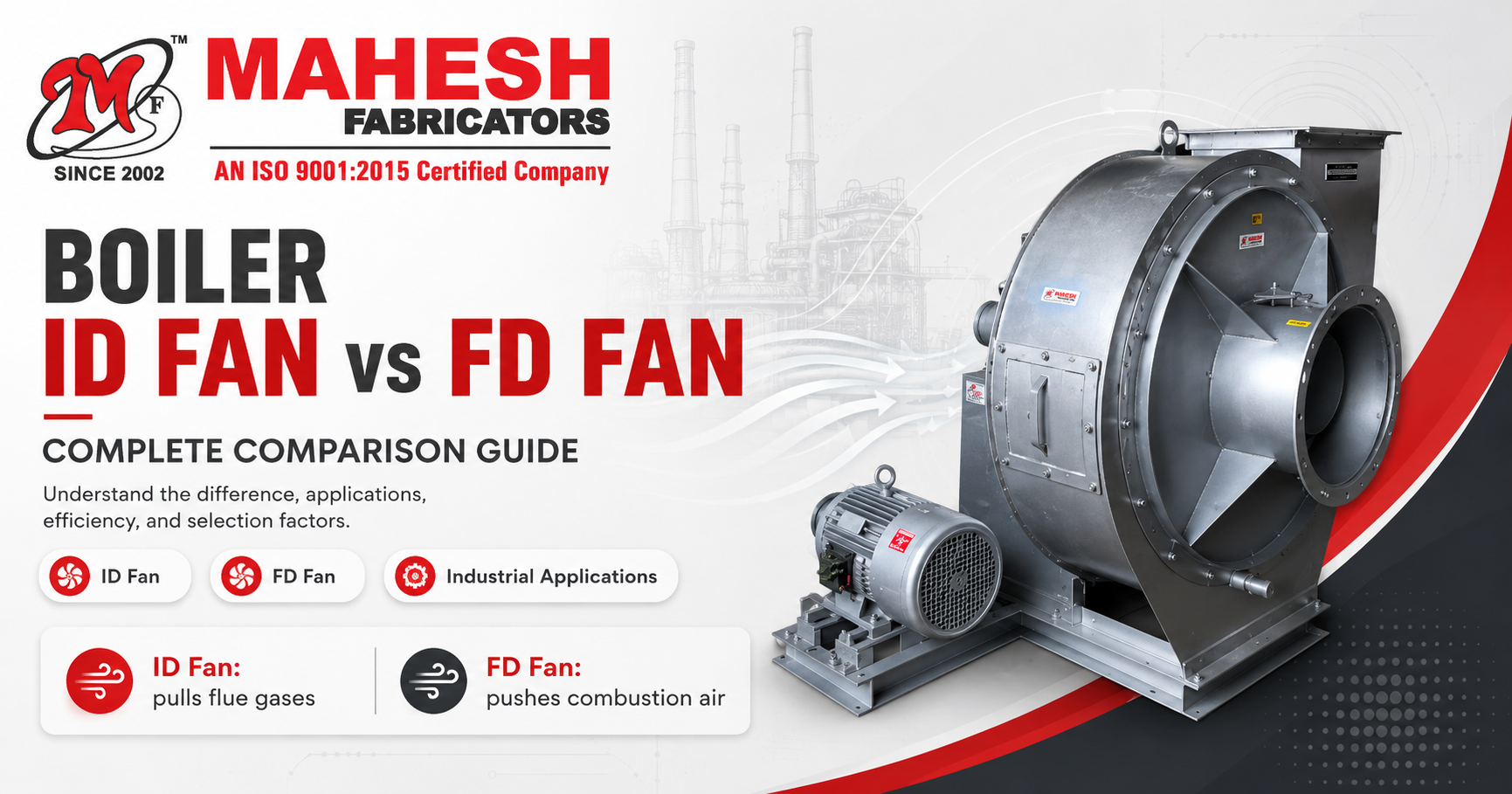
Boiler ID Fan vs FD Fan: Complete Comparison Guide
Understand the critical differences between Boiler ID Fan and FD Fan for your industrial applications in Ahmedabad. Make an informed choice with Mahesh Fabricat
Why This Matters in Ahmedabad
Ahmedabad, a major industrial hub in Gujarat, hosts a diverse range of manufacturing sectors, including textiles, pharmaceuticals, chemicals, and heavy industries. Many of these operations rely on boilers for process heat and power generation. The specific environmental conditions and operational demands within Ahmedabad's industrial landscape necessitate robust and efficient air handling systems. Incorrect fan selection can lead to reduced boiler efficiency, increased fuel consumption, premature equipment wear, and potential environmental non-compliance. Therefore, a clear understanding of ID and FD fans is vital for maintaining operational excellence and adhering to local industrial standards in Ahmedabad.
What is a Boiler ID Fan vs FD Fan — Overview
An Induced Draft (ID) Fan is positioned after the boiler, typically at the end of the flue gas path, before the chimney. Its primary role is to create a negative pressure within the boiler furnace and downstream equipment, drawing the flue gases out and expelling them into the atmosphere. This negative pressure helps to control the flow of combustion air and flue gases, preventing leaks of harmful gases into the boiler room. Conversely, a Forced Draft (FD) Fan is located before the boiler, usually at the air intake. It actively pushes or forces fresh air into the furnace, ensuring a consistent and adequate supply of oxygen for efficient fuel combustion.
Key Features and Technical Specifications
Induced Draft (ID) Fan:
Operates under negative pressure to extract flue gases.
Typically handles hot, corrosive, and particulate-laden gases.
Requires robust construction materials resistant to high temperatures and abrasion.
Designed for high static pressure to overcome resistance from the chimney and ducting.
Often features a backward-curved or airfoil impeller for efficiency.
Motor is usually located outside the airstream to protect it from heat.
Forced Draft (FD) Fan:
Operates under positive pressure to supply combustion air.
Handles ambient or pre-heated, relatively clean air.
Requires durable construction for continuous operation.
Designed for moderate static pressure to overcome resistance from the air preheater and ducting.
Commonly uses forward-curved or backward-inclined impellers.
Motor can be directly coupled or belt-driven.
Industrial Applications and Use Cases
Induced Draft (ID) Fan Applications:
- Power Plants: Essential for removing flue gases from large boilers, maintaining draft, and controlling emissions.
- Cement Plants: Used to extract kiln gases and dust, ensuring proper ventilation and process control.
- Steel and Iron Foundries: Manages high-temperature exhaust gases from furnaces and heat treatment processes.
- Chemical Plants: Handles corrosive and toxic fumes generated during various chemical reactions.
- Waste-to-Energy Facilities: Extracts combustion gases from incinerators and boilers.
Forced Draft (FD) Fan Applications:
- Boiler Systems: Supplies the primary combustion air for efficient burning of fuels.
- Furnaces and Kilns: Provides the necessary airflow for high-temperature industrial heating processes.
- Drying Systems: Delivers heated air for industrial drying applications in textiles, food processing, and wood products.
- Ventilation Systems: Used in large industrial spaces to ensure adequate fresh air supply.
- Material Handling: Can be used in pneumatic conveying systems to move bulk materials.
How to Choose the Right ID Fan or FD Fan
Selecting the correct fan is paramount for boiler efficiency and safety. Consider these factors:
- Boiler Capacity and Type: The size and design of the boiler dictate the required airflow and pressure for both ID and FD fans.
- Operating Temperature: ID fans must withstand high flue gas temperatures, while FD fans handle ambient or slightly preheated air.
- Gas/Air Composition: The presence of corrosive elements, dust, or moisture in the flue gas requires specific materials and coatings for ID fans.
- Pressure Requirements: Calculate the total static pressure the fan must overcome, including ducting, filters, and chimney resistance.
- Efficiency Ratings: Higher efficiency fans consume less power, leading to significant operational cost savings over time.
- Noise Levels: Consider local regulations and workplace safety regarding fan noise emissions.
- Material of Construction: Choose materials appropriate for the operating environment (e.g., stainless steel for ID fans handling corrosive gases).
- Reliability and Manufacturer Reputation: Opt for established manufacturers with a proven track record in industrial fan production.
- After-Sales Support and Service: Ensure readily available spare parts and maintenance services.
Quality Standards and Compliance
For industrial fans, particularly those used in critical applications like boilers, adherence to quality standards is non-negotiable. Manufacturers like Mahesh Fabricators, being ISO 9001-2015 certified, demonstrate a commitment to quality management systems. Buyers should look for fans that comply with relevant Indian Standards (IS) or international standards like AMCA (Air Movement and Control Association) for performance and safety. Compliance with specific industry regulations, such as those pertaining to emissions or workplace safety, is also essential. Verifying certifications and ensuring the fan's design specifications meet the required operational parameters will prevent costly failures and ensure regulatory adherence.
Why Mahesh Fabricators' Experience and Capability Matters
With over 17 years of experience since its founding in 2002, Mahesh Fabricators has developed a deep understanding of industrial air systems. As an ISO 9001-2015 certified company, our manufacturing processes are rigorously controlled to ensure consistent quality and performance. Our team possesses the technical expertise to design and fabricate ID and FD fans tailored to the specific demands of various industries, from power plants to chemical facilities. We prioritize robust construction using appropriate materials to withstand harsh operating conditions, ensuring longevity and reduced maintenance. Our commitment extends to providing reliable after-sales support and ensuring timely delivery, making us a trusted partner for your industrial fan needs in Ahmedabad and beyond.
Installation, Maintenance, and Care Tips
Proper installation and regular maintenance are crucial for the optimal performance and lifespan of both ID and FD fans.
- Installation: Ensure fans are installed on a solid, vibration-dampening foundation. Align the fan and motor shafts precisely if using a belt drive or coupling. Verify that duct connections are airtight to prevent air leakage. Electrical connections should be made by a qualified electrician according to specifications.
- Routine Checks: Regularly inspect fan blades for wear, damage, or material buildup. Check belt tension and condition for belt-driven units. Monitor bearing temperatures and listen for unusual noises, which could indicate wear or imbalance.
- Lubrication: Follow the manufacturer's recommended lubrication schedule for bearings and any other moving parts. Use the correct type of lubricant.
- Cleaning: Periodically clean fan impellers and housings, especially for ID fans handling dusty or sticky gases, to maintain aerodynamic efficiency.
- Vibration Analysis: For critical applications, periodic vibration analysis can detect developing issues before they cause catastrophic failure.
- Performance Monitoring: Keep records of fan performance parameters like current draw, temperature, and pressure to identify any deviations from normal operation.
Frequently Asked Questions
An Induced Draft (ID) fan's main job is to create a negative pressure within the boiler's combustion chamber and flue gas passages. This negative pressure draws the hot flue gases out of the boiler and safely exhausts them through the chimney, ensuring proper airflow and preventing gas leaks into the plant environment.
A Forced Draft (FD) fan pushes fresh air into the boiler furnace to supply oxygen for combustion, operating under positive pressure. In contrast, an Induced Draft (ID) fan pulls the flue gases out* of the boiler and towards the chimney, operating under negative pressure.
No, it is generally not advisable. ID fans are designed to handle hot, potentially corrosive flue gases and operate under negative pressure, often requiring more robust materials and specific aerodynamic designs. FD fans handle cleaner, cooler air and operate under positive pressure. Using them interchangeably can lead to premature failure and inefficiency.
For ID fans exposed to corrosive flue gases, materials like stainless steel (e.g., SS 304, SS 316), special alloys, or fans with specialized coatings are commonly used. The specific choice depends on the temperature, chemical composition, and concentration of corrosive elements in the flue gas.
Fan efficiency directly affects the overall energy consumption of the boiler system. A more efficient fan requires less power to move the required volume of air or gas, leading to lower electricity costs. It also contributes to better combustion control and can indirectly improve boiler thermal efficiency.
For an FD fan, regular checks on the motor, bearings, and impeller are critical. Ensuring proper lubrication of bearings, maintaining correct belt tension (if applicable), and keeping the impeller clean from dust buildup will prevent premature wear and ensure consistent airflow for combustion.
Conclusion
Choosing between an Induced Draft (ID) Fan and a Forced Draft (FD) Fan, or understanding their respective roles in your boiler system, is fundamental to efficient and safe industrial operations. The ID fan manages the exhaust, ensuring flue gases are safely removed, while the FD fan drives the combustion process by supplying essential air. Factors like operating temperature, gas composition, pressure requirements, and material durability are key considerations. For industries in Ahmedabad and across Gujarat, partnering with experienced manufacturers like Mahesh Fabricators, an ISO 9001-2015 certified company with a proven track record, ensures you receive reliable, high-performance fans tailored to your specific needs, backed by essential technical support.
Get In Touch
Mahesh Fabricators