Axial Flow Fan Working Principle
An axial flow fan is one of the most commonly used air-moving devices in industrial ventilation, cooling, exhaust, drying, and process air applications. The axial flow fan working principle is based on moving air parallel to the fan shaft. In simple terms, air enters the fan from one side and travels straight through the fan in the same axial direction. This design makes axial fans suitable for applications where a large volume of air needs to be moved at low to medium pressure.
Understanding the axial flow fan working principle is important for industries that depend on proper air circulation, heat removal, fume extraction, equipment cooling, and workplace ventilation. Although a fan may look simple from the outside, its performance depends on blade design, motor speed, airflow resistance, installation method, and working environment. When these factors are clearly understood, it becomes easier to select, operate, and maintain the right fan system.
Mahesh Fabricators is an ISO 9001:2015 certified company engaged in manufacturing industrial air pollution control equipment and air movement solutions. The company works with industrial fans, blowers, centrifugal fans and blowers, hot air blowers, accessories, air pollution control equipment, and portable dust collectors. With experience in industrial airflow systems, Mahesh Fabricators focuses on performance, reliability, precision engineering, and long operational service life.
What Is an Axial Flow Fan?
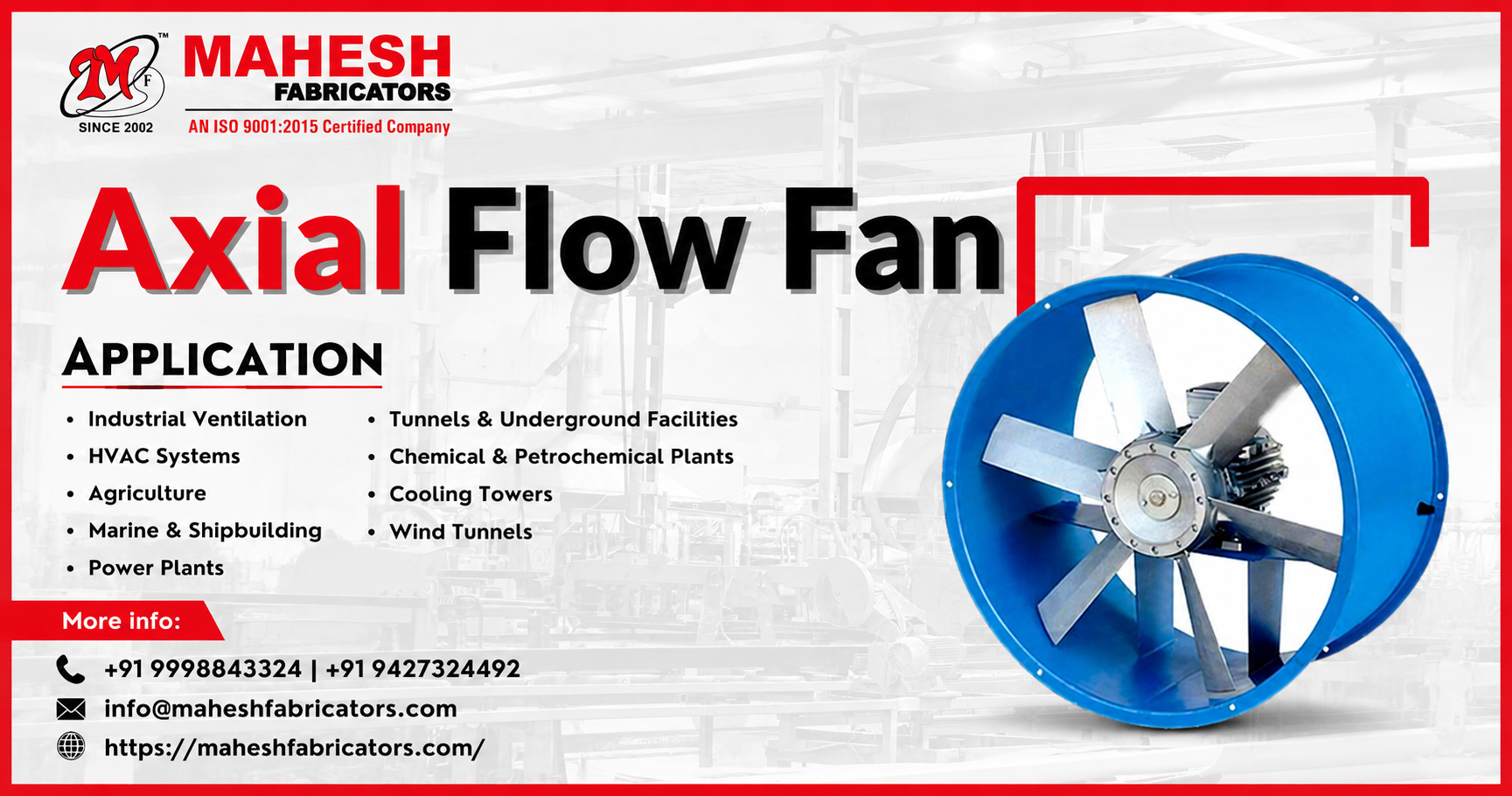
An axial flow fan is a mechanical device designed to move air or gas along the axis of rotation. The word “axial” refers to the direction of airflow. In this type of fan, air flows in a straight line, parallel to the shaft on which the fan blades are mounted.
The basic construction of an axial flow fan includes a motor, shaft, hub, blades, casing or frame, guard, and mounting arrangement. When the motor rotates the fan shaft, the blades cut through the air and create a pressure difference. This pressure difference pulls air from the inlet side and pushes it toward the outlet side.
Unlike centrifugal fans, which change the direction of airflow, axial fans maintain a straight airflow path. This makes them useful where high air volume is required without complex ducting or high-pressure resistance. They are widely used in ventilation systems, cooling units, exhaust systems, industrial sheds, process areas, and machinery cooling applications.
How Axial Flow Fan Working Principle Works
The axial flow fan working principle depends on the aerodynamic action of rotating blades. When the fan blades rotate, they work like airfoils. Each blade is designed with a specific angle and shape to move air efficiently. As the blades spin, they create a low-pressure area at the inlet and a higher-pressure area at the outlet.
Air moves through the fan due to the pressure difference created by the rotating blades. This continuous movement forms a steady stream of air in the axial direction. The faster the blades rotate, the greater the volume of air moved, depending on blade size, pitch, motor power, and system resistance.
Blade angle plays a major role in airflow performance. A steeper blade angle can move more air but may require more motor power. A lower blade angle may consume less energy but move less air. For this reason, axial fan design must balance airflow requirement, pressure condition, noise level, and energy efficiency.
In industrial applications, a fan is often selected based on airflow volume, static pressure, operating temperature, duty cycle, and installation conditions. A properly designed axial flow fan can provide effective ventilation and cooling with reliable performance.
Difference Between Axial Flow Fan and Centrifugal Fan
Axial flow fans and centrifugal fans are both used for air movement, but their working methods are different. In an axial fan, air flows parallel to the shaft. In a centrifugal fan, air enters near the center and is discharged at a right angle through centrifugal force.
Axial fans are generally preferred where large airflow volume is needed with lower pressure resistance. Centrifugal fans are preferred where higher pressure is required, especially in ducted systems, dust collection, air pollution control, and process air handling.
This difference is important when selecting a fan. Using an axial fan in a high-pressure duct system may reduce performance. Similarly, using a centrifugal fan where simple air circulation is needed may be unnecessary. The right choice depends on airflow volume, pressure requirement, available space, noise level, and application purpose.
Applications of Axial Flow Fans
Axial flow fans are used in many industrial and commercial environments where air circulation, ventilation, or cooling is required. They are practical for applications that need direct airflow and efficient air movement.
- Industrial ventilation for removing hot or stale air
- Equipment cooling in machinery and production areas
- Exhaust systems for process rooms and work zones
- Air circulation in large enclosed spaces
- Drying support in manufacturing and processing units
The exact fan type, size, and motor rating depend on the application. A fan used for general ventilation may not be suitable for heavy-duty industrial exhaust. Correct selection improves performance, reduces downtime, and supports safer working conditions.
Benefits of Understanding Axial Flow Fan Working Principle
Knowing how an axial flow fan works helps businesses make better decisions during selection, installation, operation, and maintenance. It also helps identify performance issues early and supports better air management planning.
- Better fan selection according to airflow needs
- Improved energy efficiency through correct sizing
- Lower risk of motor overload and poor performance
- More effective ventilation and cooling
When the working principle is clear, users can avoid common mistakes such as wrong fan orientation, incorrect mounting, undersized motor selection, or using the fan in unsuitable pressure conditions.
Factors to Consider Before Selecting an Axial Flow Fan
Before choosing an axial flow fan, it is important to study the operating requirement carefully. Fan selection should not be based only on physical size. Actual airflow requirement, static pressure, temperature, duty hours, space limitation, and safety needs must be considered.
- Required airflow volume
- Static pressure condition
- Motor power and speed
- Blade size and pitch
- Installation position
- Noise level requirement
A correctly selected axial fan performs more efficiently and requires less maintenance. Oversized fans may waste energy, while undersized fans may fail to provide proper ventilation or cooling.
Role of Axial Flow Fans in Industrial Air Management
Industrial facilities need reliable air management to maintain working conditions, protect equipment, and support process efficiency. Axial flow fans help move large volumes of air for ventilation, cooling, and exhaust needs. They are useful where direct air movement is required across open spaces or specific equipment zones.
In production environments, heat, fumes, dust, and stagnant air can affect worker comfort and equipment performance. A well-designed airflow system helps reduce these issues. Axial fans support this system by creating continuous air exchange and improving air circulation.
Mahesh Fabricators works with industrial air movement and air pollution control equipment, helping industries manage airflow needs through engineered solutions. The company’s focus on energy efficiency, reliability, precision engineering, and quality assurance supports dependable performance in demanding industrial environments.
FAQs
Conclusion
The axial flow fan working principle is simple yet highly effective for industrial air movement. By moving air parallel to the fan shaft, axial fans provide large-volume airflow for ventilation, cooling, exhaust, and circulation applications. Their performance depends on blade design, motor power, airflow resistance, installation method, and maintenance quality.
For industries, understanding how axial flow fans work helps in selecting the right system, improving energy efficiency, reducing downtime, and maintaining safe working conditions. A properly selected and maintained axial flow fan can support reliable air management across many industrial processes.
Mahesh Fabricators, an ISO 9001:2015 certified company, works with industrial fans, blowers, air pollution control equipment, and related air movement solutions. With a focus on engineering reliability, quality assurance, and industrial performance, the company supports practical airflow requirements for different industrial operations.