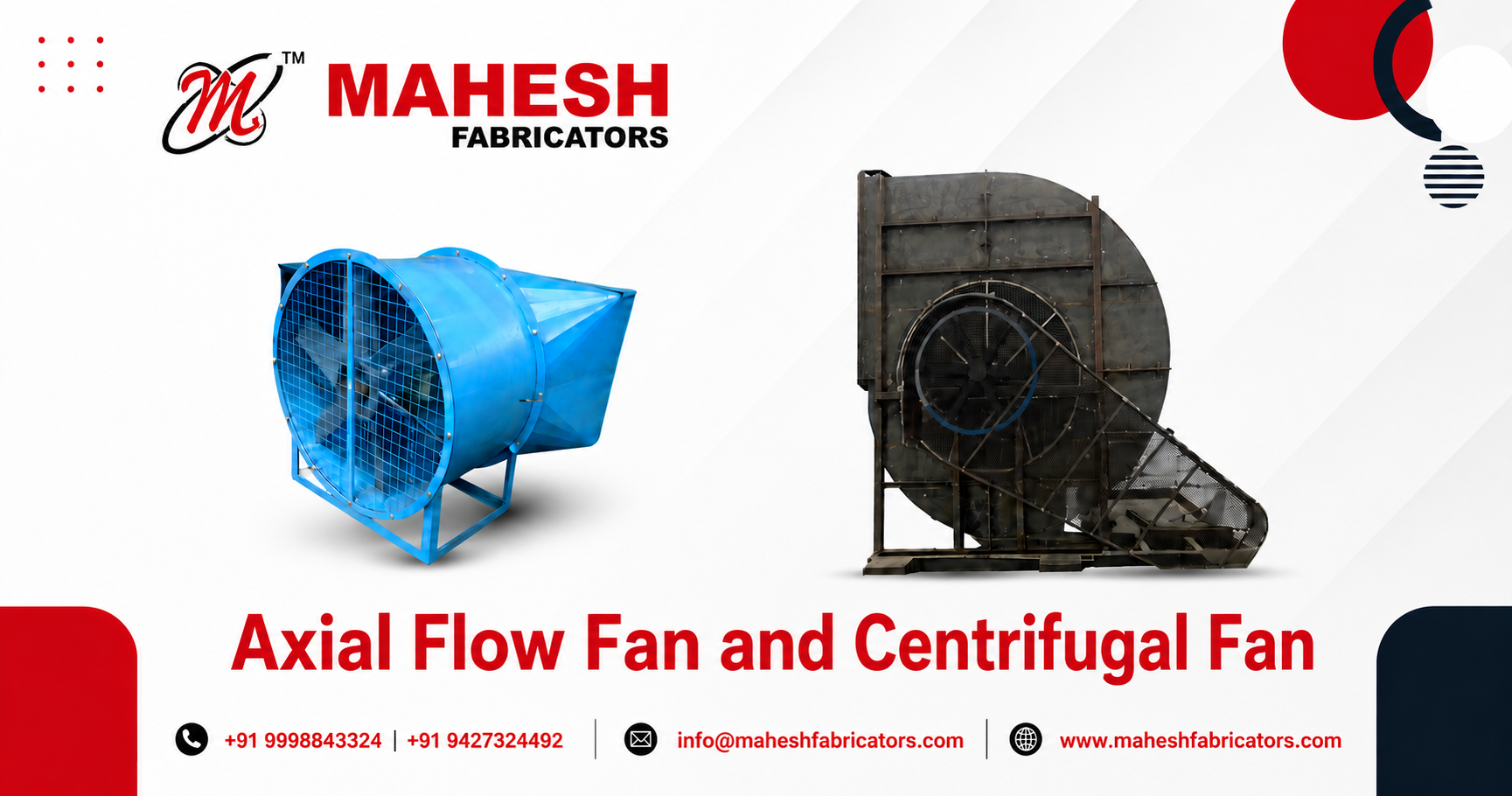
Axial Flow Fan and Centrifugal Fan
Axial Flow Fan and Centrifugal Fan are two essential types of industrial air movement equipment used in manufacturing plants, processing units, ventilation systems, air pollution control setups, dust collection systems, cooling operations, and process air applications. Both fans are designed to move air, gases, fumes, or light particles, but their working principles, airflow direction, pressure handling capacity, and application suitability are different.
In industrial environments, proper air movement is not only a comfort requirement. It is closely connected with machine performance, worker safety, process stability, temperature control, dust handling, and overall operational efficiency. Choosing the right fan system helps industries maintain controlled airflow, improve ventilation, reduce heat build-up, and support cleaner working conditions.
Mahesh Fabricators is an ISO 9001-2015 certified company founded in 2002 and engaged in manufacturing industrial air pollution control equipment, industrial fans, centrifugal blowers, blower accessories, dust collectors, and air handling solutions. With experience in industrial blower and fan manufacturing, the company focuses on engineering-based solutions that support practical industrial requirements.
Understanding Axial Flow Fan and Centrifugal Fan
Axial Flow Fan and Centrifugal Fan are often compared because both are used for air movement, but they are designed for different operating conditions. An axial flow fan moves air parallel to the shaft or axis of the fan. The airflow enters and exits in the same direction, making it suitable for applications where large volumes of air need to be moved at relatively low pressure.
A centrifugal fan, on the other hand, moves air at a right angle to the inlet direction. Air enters near the center of the impeller and is pushed outward by centrifugal force. This design allows centrifugal fans to generate higher pressure compared to axial fans, making them suitable for ducted systems, dust collection units, air pollution control equipment, and process ventilation.
Understanding this difference is important because fan selection directly affects airflow efficiency, energy use, system performance, and equipment life. A fan that works well for general ventilation may not be suitable for high-resistance ducting or dust-laden air. Similarly, a high-pressure fan may not be the right choice for simple open-area air circulation.
How Centrifugal Fans Work
Centrifugal fans operate with an impeller enclosed inside a housing. Air enters the fan from the inlet side and reaches the center of the impeller. As the impeller rotates, centrifugal force pushes the air outward toward the fan casing and then discharges it through the outlet.
This design allows centrifugal fans to handle higher pressure and maintain controlled airflow. Because of their pressure-generating ability, they are widely used in industrial systems where air must pass through ducts, filters, dust collectors, air pollution control equipment, furnaces, dryers, and process machinery.
Centrifugal fans are available in different designs depending on air volume, pressure requirement, temperature condition, dust load, and application type. Their robust structure makes them suitable for demanding industrial operations where airflow stability and long-term reliability are important.
Key Difference Between Axial Flow Fan and Centrifugal Fan
The main difference between Axial Flow Fan and Centrifugal Fan is airflow direction and pressure generation. Axial fans move air in a straight line along the fan axis, while centrifugal fans change the airflow direction and discharge it at an angle from the inlet.
Axial fans are preferred when the requirement is high-volume airflow with low resistance. Centrifugal fans are preferred when the system requires higher pressure, better airflow control, and the ability to move air through ducts or connected equipment.
Another important difference is application suitability. Axial fans are commonly used for ventilation, cooling, and air circulation, while centrifugal fans are commonly used in dust collection, fume extraction, pneumatic conveying support, combustion air supply, and air pollution control systems.
Both fan types have their own importance. The right selection depends on the actual operating condition, not only on airflow capacity.
Industrial Applications of Axial Flow Fan and Centrifugal Fan
Axial Flow Fan and Centrifugal Fan are used across different industrial sectors depending on air movement requirements. Their applications vary based on airflow volume, pressure condition, space availability, ducting design, and process needs.
Common applications include:
In industries where fresh air circulation is needed, axial fans may be suitable. In systems where air must move through filters, ducts, cyclones, scrubbers, or dust collectors, centrifugal fans are generally more suitable because of their pressure capability.
Importance of Proper Fan Selection
Selecting the right fan is important for safe and efficient industrial operation. A fan should not be selected only by size or motor rating. The actual requirement depends on air volume, static pressure, air temperature, dust load, duct length, system resistance, operating hours, and installation conditions.
If an axial fan is used in a high-resistance system, airflow may drop and the fan may not perform as expected. If a centrifugal fan is used where only open ventilation is needed, the system may become unnecessarily complex. Correct fan selection helps reduce energy wastage, improve airflow stability, and extend equipment life.
A properly selected fan also supports workplace safety. Poor ventilation can lead to heat accumulation, dust concentration, fumes, moisture issues, and uncomfortable working conditions. In process industries, unstable airflow can also affect production quality and machine performance.
Quality Factors in Industrial Fan Manufacturing
Industrial fans work in demanding conditions, so design and manufacturing quality are important. A reliable fan requires proper material selection, balanced impeller design, strong fabrication, accurate alignment, and suitable motor selection. Even small errors in design or balancing can create vibration, noise, energy loss, and premature wear.
Important quality factors include:
Mahesh Fabricators follows quality-focused manufacturing practices for industrial fans and blower systems. As an ISO 9001-2015 certified company, the focus remains on consistent manufacturing, practical performance, and reliable industrial use.
Maintenance of Axial Flow Fan and Centrifugal Fan
Regular maintenance helps improve fan performance and reduce unexpected downtime. Industrial fans operate for long hours, often in dusty, hot, or process-heavy environments. Over time, dust deposition, belt looseness, bearing wear, vibration, and alignment issues can affect performance.
Basic maintenance includes checking fan blades or impellers, cleaning accumulated dust, inspecting bearings, checking motor condition, tightening fasteners, monitoring vibration, and ensuring a clear airflow path. For centrifugal fans, duct connections and filters should also be checked because blockage can increase system resistance.
Maintenance should be planned based on operating hours and site conditions. A fan installed in a clean ventilation area may need less frequent cleaning, while a fan used in dust collection or fume extraction may require more regular inspection.
FAQs
Conclusion
Axial Flow Fan and Centrifugal Fan are both essential for industrial air movement, but they serve different purposes. Axial fans are suitable for high-volume, low-pressure air circulation, while centrifugal fans are suitable for higher-pressure applications, ducted systems, dust collection, and air pollution control equipment.
The right fan selection improves ventilation, supports process efficiency, reduces operational issues, and helps maintain safer working conditions. Industries should consider airflow volume, static pressure, application type, ducting, dust load, temperature, and maintenance needs before choosing a fan system.
Mahesh Fabricators, an ISO 9001-2015 certified company founded in 2002, manufactures industrial air pollution control equipment, industrial fans, centrifugal blowers, and related air handling solutions. With engineering experience and a focus on quality, the company supports industries with practical and reliable fan systems designed for real operating conditions.