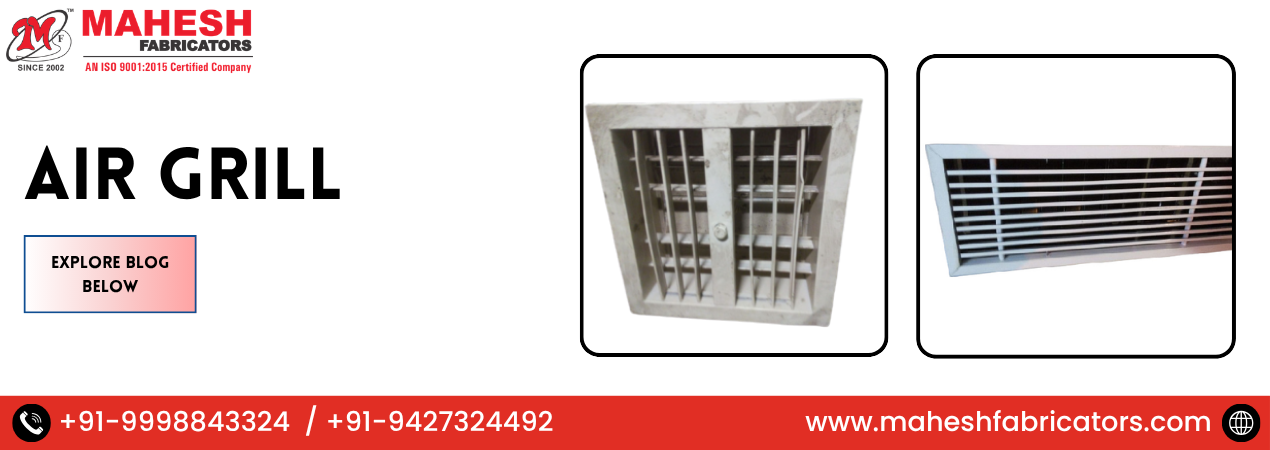
Air Grill
Air grills are essential components in modern ventilation and air distribution systems. They allow controlled airflow into or out of spaces while maintaining proper circulation and ventilation efficiency. Across industrial, commercial, and residential environments, air grills help maintain air quality, temperature balance, and overall system performance.
Mahesh Fabricators, an ISO 9001-2015 certified company established in 2002, specializes in manufacturing industrial air pollution control equipment and ventilation components. With a strong focus on durability and functional design, the company produces air grills widely used in HVAC systems, kitchen exhaust setups, and industrial ventilation networks.
Understanding the Function of Air Grills in Ventilation Systems
Air grills are primarily used to facilitate the movement of air between spaces or within duct systems. Unlike diffusers, air grills typically do not include air control dampers, meaning they are designed for unrestricted airflow. This makes them suitable for applications where consistent air passage is required without frequent adjustment.
In HVAC systems, air grills function as intake or outlet points, ensuring that conditioned air is distributed evenly throughout a space. They also help maintain proper airflow patterns, reducing the chances of stagnation and uneven temperature distribution.
Role of Air Grills in HVAC Efficiency
In HVAC systems, air grills contribute directly to efficiency by enabling smooth and consistent airflow distribution. Properly designed grills minimize airflow resistance, allowing systems to operate effectively without unnecessary energy consumption.
They also support indoor air quality by ensuring continuous air exchange. This is particularly important in environments where fresh air circulation is required to prevent the buildup of pollutants or excess humidity.
Key Applications of Air Grills
Air grills are widely used across various industries due to their versatility and functionality. Their applications depend on system design and airflow requirements.
Installation Considerations for Air Grills
The effectiveness of an air grill largely depends on correct installation and alignment within the ventilation system. Several factors should be considered to ensure optimal performance.
Importance of Air Circulation in Industrial Environments
In industrial environments, maintaining proper air circulation is essential for both operational efficiency and worker safety. Air grills play a key role in distributing fresh air evenly across large spaces.
They help remove heat, fumes, and airborne particles, especially in manufacturing units, workshops, and processing plants. This contributes to a safer, cleaner, and more comfortable working environment.
Advantages of Using Air Grills in Ventilation Systems
Air grills offer several functional advantages, making them a preferred choice in ventilation and HVAC systems.
Maintenance and Durability of Air Grills
Air grills are designed for long-term durability and require minimal maintenance. Regular cleaning is generally sufficient to maintain optimal performance and prevent the buildup of dust or debris.
Their sturdy construction enables them to withstand continuous airflow and exposure to various environmental conditions. In industrial settings, this durability ensures uninterrupted operation.
Frequently Asked Questions
Conclusion
Air grills are a fundamental component of ventilation and HVAC systems, offering a simple yet effective solution for maintaining airflow and air quality. Their practical design, durability, and versatility make them suitable for a wide range of applications, from industrial environments to commercial and residential spaces.
With reliable performance and low maintenance requirements, air grills contribute significantly to the efficiency of ventilation systems. Their role in ensuring consistent air circulation underscores their importance in modern infrastructure and industrial operations.